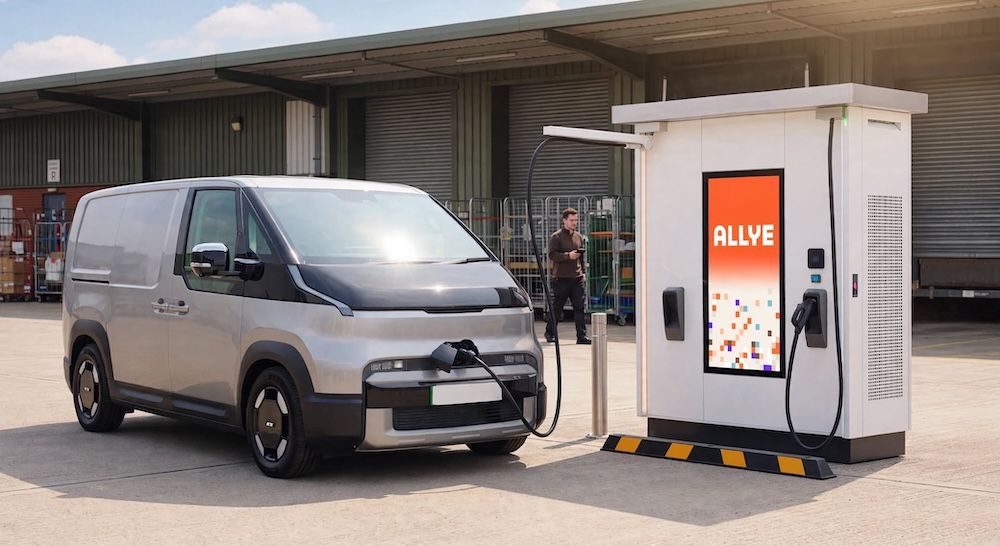
Clean-tech innovator Allye Energy has launched the Allye MEV, an electric vehicle (EV) charger with built-in battery storage made from whole repurposed EV packs.
MEV charges itself from a depot’s supply, and releases energy up to 400kW to two vehicles at once. Engineered and built in the UK with batteries from UK-registered vehicles and 95% British-sourced components, the range starts at £70,000, with deliveries expected Q2 2027, in time for Round 2 of the UK government’s Depot Charging Scheme.
Grid capacity is the biggest single barrier to fleet electrification, named by 47% of delegates polled at this year’s Transport + Energy Fleet Electrification Forum. A new depot connection takes 18 to 36 months, according to the freight infrastructure body TwentyForty, and the UK Government said some businesses wait up to 15 years, with the connection queue up tenfold in five years.
Allye and partner Chargepoly brought battery-buffered charging to J&M Murdoch’s refuse depot in Glasgow, where a grid upgrade was quoted at £300,000. Within a day, its MAX300 was buffering the existing 32A (22kW) supply, and now powers a satellite DC fast charger supporting two EVs and supplying around 200kWh a day. MEV now turns this approach into a dedicated, fixed charger.
MEV launches in two variants, the MEV200 and MEV300, with 155kWh and 232kWh of energy storage from repurposed EV battery packs. Reusing those packs avoids an estimated 15 to 24 tonnes of CO2e per MEV compared with new cells, often imported from China.
The unit is protected with every MEV cable having cut detection, forensic marking and quick-release terminals for fast replacement.
Smart lighting shows each charger’s status at a glance, and optional AI bay monitoring flags a car blocking a charger or an EV overstaying. At high-footfall public sites, the 65-inch front screen can carry advertising between sessions, with 65-inch side screens as an option.
Robert Carter, Chief Technology Officer at Allye Energy, said:
“MEV is the direct result of our work on the MAX300. The hard part was never the battery. It was making packs of different sizes and ages behave as one system and deliver up to 400kW of DC charging through an 800V architecture and our in-house technology stack.
“Once we had solved that, MEV was the obvious next step: the same architecture in a cabinet that only ever charges, where one pack can slide out for service while the others keep charging.”
Jonathan Carrier, Founder and CEO of Allye Energy, said:
“We have built two ranges, not two versions of the same thing. If the charger stays put and only ever charges vehicles, MEV does it on the supply you already have, often for less than the connection works it replaces. If the energy needs to move, towed behind a van or feeding a row of chargers, that is the MAX300. But better products are only half the answer.
“To deploy charging at the pace the transition needs, we have to make it far cheaper, and that takes innovation in the business model and the supply chain as well as the product. Charging as a service, a monthly fee instead of a capital bill, is how fleets, depots and local authorities get more charging for less.”
Image courtesy of Allye