Around 4,500 tonnes of CO2 were saved from 11 National Highways-funded road construction and resurfacing schemes last year.
The schemes reduced carbon emissions by using low carbon construction methods, as well as materials which will reduce carbon emissions over the whole life of the road surface.
Through the Low Carbon Demonstrator Fund, National Highways is scaling-up the use of market-ready low-carbon techniques for resurfacing on England’s major roads, with the organisation investing around £2.5 million.
Many of the schemes used materials such as long-life binders which are designed to make the road surface more resilient, reducing the need for further maintenance, and reduce costs and carbon over the whole lifespan of the road surface.
Building materials firm Holcim estimated the long-life binder used on a resurfacing scheme on the M5, between J28-30, could increase the service life from 15 to 20 years. The Fund also demonstrated how low carbon plant machinery could be deployed for on-site equipment.
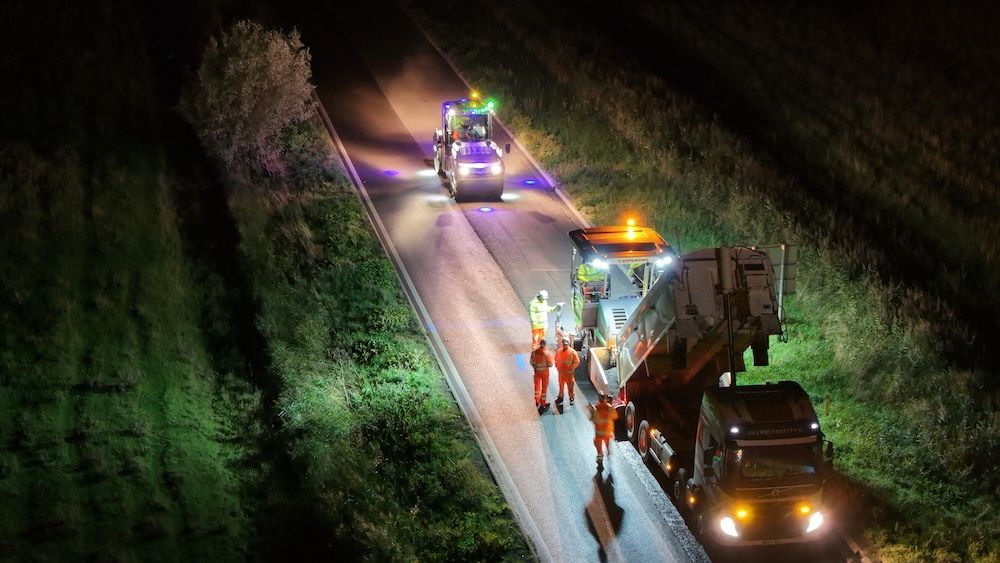
On the M4, FM Conway used an electric roller and electric paver as well as a hydrogen loader to carry out works. Combined with low carbon asphalt, the project demonstrated how sustainable road construction can be delivered at scale.
Meanwhile, Heidelberg estimated the use of an electric paver on a stretch of the A47 from Acle to Yarmouth could cut the carbon associated with road laying equipment by up to 70%. Alongside this, the scheme also utilised cold recycled bound materials to significantly reduce carbon.
National Highways Head of Carbon and Air Quality Angela Halliwell said:
“We’re changing the way we work to decarbonise construction and maintenance on our roads and meet the crucial challenge of helping the UK to thrive as a low carbon economy head on.
“Our Low Carbon Demonstrator Fund is helping make these possible and together we’re making positive steps towards a sustainable future. Projects like these will help pave the way for industry-wide changes, resulting in significant carbon savings, improved roads for drivers, and quieter roadworks for our neighbours.”
National Technical Manager for Contracting at Holcim Neil Leake said:
“We wanted to share the success of this scheme, which demonstrates how collaboration can accelerate innovation from concept to carriageway.
“Making roads last longer is the most effective form of carbon reduction. Employing materials and technologies like these is essential for pushing the industry toward a more sustainable future.”
Framework Delivery Manager at FM Conway Andy Weymouth said:
“Delivering this scheme on time and to such a high standard was only possible through genuine collaboration with our partners – we all played a vital role. It took belief in a shared goal and a healthy dose of commitment to integrate the use of these new technologies effectively.
“By working together, we overcame challenges and set a new benchmark for how sustainable road construction can be achieved on the strategic road network. This scheme is proof that when we unite expertise and resources, we can accelerate the transition to greener infrastructure and deliver real impact.”
Managing Director of Contracting at Heidelberg Materials UK Scott Cooper said:
“The scheme is a great example of supply chain collaboration in action. We worked with National Highways and scheme designer WSP to make the case for using evoBuild foamed asphalt for the binder course.
“It is a cold recycled bound material (CRBM) manufactured by injecting water and air into hot bitumen under high pressure. It allows the re-use of the existing road and is produced at a lower temperature, resulting in significant carbon savings.”
Image courtesy of National Highways