There’s a warning that policy inconsistency risks holding back the electric vehicle transition, with progress depending on how effectively vehicles, charging, energy and skills develop together.
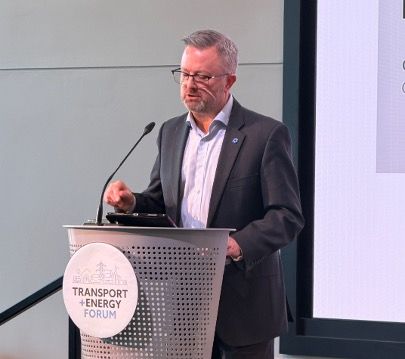
Delivering a keynote on what the world is showing us about mobility transformation at the Transport + Energy Forum, Chris Mason, CEO of FISITA told the 200 delegates that international experience demonstrated that better vehicle technology alone would not deliver mass adoption.
“Inconsistency has a cost,” he warned. “Sudden changes in policy, fragmented standards, or unclear delivery targets or responsibilities create hesitation with consumers, fleets, and investors.”
FISITA is a global alliance which brings together technology and engineering leaders to share knowledge and collaborate on the advancement of mobility, connecting more than 200,000 professionals across over 35 countries. Its corporate members span vehicle manufacturing, technology and energy, including Toyota, BMW Group, Bosch Mobility, CATL, bp and EDF.
Mason said the value of this international network was in sharing experience, rather than expecting every country to take an identical approach.
“The value of our global alliance, therefore, within this consideration, is not that every market should follow the same path,” he explained. “It is that no market should have to learn every lesson alone or over and over again.”
Mechanical excellence remained fundamental, but now sat alongside electronics, connectivity, software, data, cyber security and systems integration. Electric powertrains had added another dimension by connecting vehicles directly to energy infrastructure.
“Success in the next era, we feel, will not be defined by excellence in one component alone,” said Mason. “It will depend on how effectively countries and organisations combine their collective capabilities across the entire ecosystem.”
The vehicle, he added, was now one component within a connected transport, energy and digital ecosystem. While there was no single model of success internationally, Mason identified recurring themes. Technology readiness did not automatically create mass adoption: capable vehicles could still struggle where affordability, charging accessibility or consumer confidence remained barriers.
Infrastructure had also become part of the product proposition and a source of competitive advantage. Markets making sustained progress tended to align industrial policy, energy planning, infrastructure delivery and consumer measures more effectively.
For mass adoption, he said affordable and desirable vehicles, available charging, flexible and smart demand management, and stable policy supporting investment needed to develop together. Weakness in one area could constrain progress across the system.
Electrification was also changing when, where and how electricity was consumed, with implications for the planning and management of homes, workplaces and services.
“It also creates an important strategic opportunity, enabling vehicles to become flexible energy assets rather than simply additional demand,” he explained. “But realising this value requires cross-sector, multidisciplinary coordination.”
He says that for the UK, the challenge is to connect its existing engineering, energy, digital and financial strengths more effectively. Confidence depends on reliable delivery as well as clear communication, giving households, fleets, charge point operators and investors a credible basis for decisions.
“We know that markets lose momentum when confidence is repeatedly challenged,” he said. “So, for the UK, consistency may be one of the most valuable and least capital-intensive tools available right now.”
Mason called for companies to collaborate on shared barriers such as skills, standards, safety and interoperability, while continuing to compete on products, services and customer experience.
Workforce development also needed immediate attention through attracting talent, accelerating training and improving access to continuing professional development.
He concluded with three priorities for turning technological progress into delivery:
First, plan transport and energy as one system, aligning vehicles, charging, grid capacity, flexibility and local delivery from the outset.
Second, build confidence through consistency, giving consumers, fleets, delivery partners and investors a stable basis on which to act.
Third, develop the people and partnerships that make delivery possible, investing in capability and strengthening collaboration across the sectors.
For Chris Mason, the global lesson was clear: the UK’s opportunity lies in connecting its strengths across transport and energy to turn technological progress into coordinated delivery.