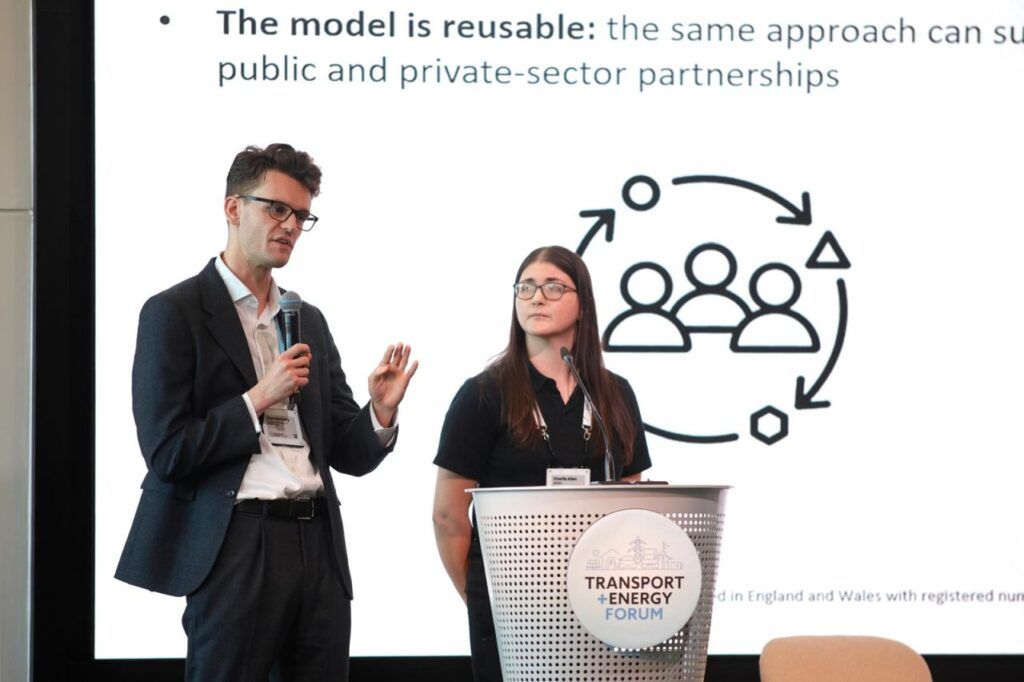

In a panel with JLR, Renault, The AA and EVUK, the organisations explained how the sector is moving beyond the ZEV Mandate as EVs become increasingly a consumer and business choice.
Chaired by Shoosmiths’ Chris Pritchett, he called on the panel to explain how the sector was responding to consumer and business demand.
Renault UK’s Adam Wood said that the volatility in prices of petrol and diesel was “a pattern now, not a blip” and “doing the maths” meant the people were drawn to EVs.
He also said the biggest challenge was around the “two tier system” of public and domestic charging, and that was the “number one issue”, a situation Tanya Sinclair agreed with as the “haves and have nots” in relation to driveways – and it was “unbelievable” that we haven’t found a solution yet. She added that it wasn’t always the case of “going to government with a begging bowl” to find a solution for the industry.
JLR’s Alison Nuttall said that the situation with EVs and demand was a “symptom of the geopolitical turmoil we are in”, with issues such as trade fragmentation, risks across different markets, and climate change all playing a role – alongside the ongoing fuel crisis from the conflict in the Middle East.
EVUK’s Tanya Sinclair added that EVs are not a “distressed purchase” and consumers and businesses were making the choice due to such vehicles being cheaper to buy, and cheaper to run”.
Falling “range anxiety”, excellent roadside support and improving charging and vehicle options give drivers greater confidence to go electric, according to the AA’s Edmund King.
AA president Edmund King OBE pointed to a significant improvement in the conditions facing drivers considering an EV.
The AA UK EV Readiness Index has risen from 47.5 to 60 out of 100 in little over a year, reflecting improvements in the affordability, charging and ownership experience of electric vehicles.
Just 1.2% of AA EV breakdown callouts in September 2026 were categorised as ‘out of charge’, compared with 8.3% in 2015. In 40% of those ‘out of charge’ cases the EV driver was able to drive to a charger followed by the AA patrol. Average ‘out of charge’ recovery was just 4.3miles.
In addition, 87.5% of EV breakdowns are fixed at the roadside, compared with 84.6% for petrol or diesel vehicles.
The top two breakdowns for EVs are very similar to ICE vehicles, with 25% EV breakdowns being tyres/wheels, and 17% are the 12 volt battery.
The AA also said it welcomes measures announced in the Budget aimed specifically at motorists unable to charge on their own driveway.
The Government has committed £100 million over two years from spring 2027 to reduce the cost of local, lower-powered public charging, which it estimates could save an EV driver relying on on-street charging around £150 a year.
It is also establishing a taskforce to examine whether motorists could eventually use their domestic electricity tariffs at certain local public chargers.
This follows changes introduced in October removing the need for planning permission in England for qualifying cross-pavement charging installations, potentially saving drivers up to £300.
The AA also thinks many without off-street parking could benefit from sharing neighbours’ chargers, including the Co Charger app that links the ‘Hosts’ (those with chargers) and ‘Chargees’ (those wanting a way to charge) in their neighbourhoods. There are more than a million home chargers across the UK that are used less than 6% of the time.
It also believes “tackling the gap between the experience of drivers with and without access to home charging will be crucial to the next phase of EV adoption”.
Edmund King OBE, AA president, told the Transport + Energy Forum:
“Electric vehicles have reached something of a turning point. There are still hurdles to overcome, but the direction of travel is increasingly positive.
“Our EV Readiness Index has moved from 47.5 to 60 in little over a year. That is a significant shift and shows that the conditions for going electric are becoming more favourable for more drivers.
“One of the biggest fears has always been range anxiety and the prospect of grinding to a halt with a flat battery. The reality on the road is rather different. Running out of charge now accounts for just 1.2% of the EV breakdowns we attend, compared with 8.3% in 2015.
“Perhaps even more reassuring is that when an EV does break down, our patrols are actually more likely to fix it at the roadside than a petrol or diesel car. Almost nine in ten EV breakdowns are fixed there and then.
“Drivers shouldn’t assume that going electric means being stranded at the roadside waiting for a recovery truck. The cars have improved, charging has improved and roadside assistance and training has evolved with them.
“The next challenge is to make sure the benefits of electric driving aren’t confined to those lucky enough to have a driveway.
“That is why the measures in the Budget to reduce the cost of local public charging for drivers without home charging are welcome. Combined with the removal of unnecessary planning barriers for cross-pavement charging, these measures can help make the EV transition fairer.
“We have always said the switch to electric should be an evolution rather than a revolution. Drivers need affordable cars, convenient and competitively priced charging and confidence that help will be there if things go wrong.
“We aren’t at the destination yet, but the evidence suggests we’re travelling down the right road.”