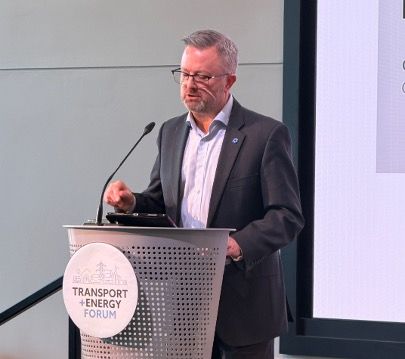

In an exclusive comment piece for Transport + Energy, chair of the EV APPG and MP Perran Moon explains that diluting the Zero Emission Vehicle (ZEV) Mandate “would be a terrible mistake”.
Economically, politically, and environmentally, diluting the ZEV Mandate would be a terrible mistake. Here’s why.
UK automotive manufacturing is overwhelmingly an export-led industry. Almost 80% of all UK-manufactured cars are exported and, as the cars we buy are imported, less than one in ten new car registrations are UK-manufactured cars subject to the ZEV mandate. Attributing the industry’s struggles to the ZEV mandate is, therefore, misleading. Instead, cutting the ZEV mandate would replace policy certainty with renewed doubt, placing billions of pounds of EV supply chain and infrastructure investment at risk and undermining consumer confidence.
Some say that the UK market for EVs isn’t growing fast enough, comparing the 27% EV market share this year with the 33% ZEV mandate headline target. This is simply a misrepresentation. Manufacturers receive extensive flexibilities through the mandate. Once those flexibilities are accounted for, New AutoMotive calculates this year’s effective target at 24.6%. The industry is therefore on course to comfortably meet its target, as it has done every year since the mandate was introduced. Equating the headline target with the actual compliance requirement creates the impression of the mandate failing, when, in fact, it is operating exactly as designed.
It’s also misleading to suggest that every EV sold has required huge support from Government grants and manufacturer discounts, treating discounting as an EV-specific phenomenon, rather than the longstanding feature of the new car market that it is. Over the 12 months to July 2026, manufacturers spent £7.6bn discounting petrol, diesel and hybrid cars, compared with £3.1bn in EV discounts, including the Government’s Electric Car Grant.
Neither targeted incentives nor commercial discounting demonstrate an absence of demand. Quite the opposite: UK EV sales are up 27% year-on-year and September delivered record EV registrations, with average new EV prices already achieving parity with petrol and diesel cars and expected to fall below them from 2027.
This direction of consumer travel is replicated in the EU. In October, Germany and France achieved respective EV market shares of 37% and 41%, compared with 32% in Britain. Given that 60% of UK car exports go to the EU, if our manufacturers fail to cater to changing international demand, we will be stuck producing yesterday’s technology and risk being crowded out of the export markets on which we rely. According to the Energy & Climate Intelligence Unit, doing so threatens 127,000 jobs and £70bn in GVA, whereas a faster transition to EVs could support 142,000 new jobs and £87bn in GVA over the next decade.
Every Labour MP was elected on a manifesto commitment to ban the sale of new petrol and diesel vehicles by 2030. Further dilution of the ZEV mandate profoundly undermines that position. The fact is that lobbying of Government to weaken the mandate has little to do with the mandate itself; it has everything to do with a desire to push back that 2030 ban.
Finally, there is no credible argument for claiming that such a substantial retreat on the ZEV mandate would leave our climate ambitions intact. Were the Government to cut the 2030 target to 50% and extend the flexibilities, Transport & Environment calculates that the resulting additional petrol demand would be double the expected annual output of the Rosebank oil field. The Climate Change Committee has warned that weakening the mandate would leave the Carbon Budget off-track to a tune equivalent to 2.8mn additional heat pumps.
Diluting the ZEV mandate is the wrong answer to the right question. The UK automotive sector should be supported to overcome the real threats: competition from heavily subsidised Chinese vehicles and the imminent ‘Made in Europe’ rules. I would urge colleagues to support the Government’s ambition for a closer trading relationship with our European partners, rather than messing with the mandate.
Perran Moon is Chair of the EV APPG having spent 30 years working in the automotive industry before becoming an MP in 2024.