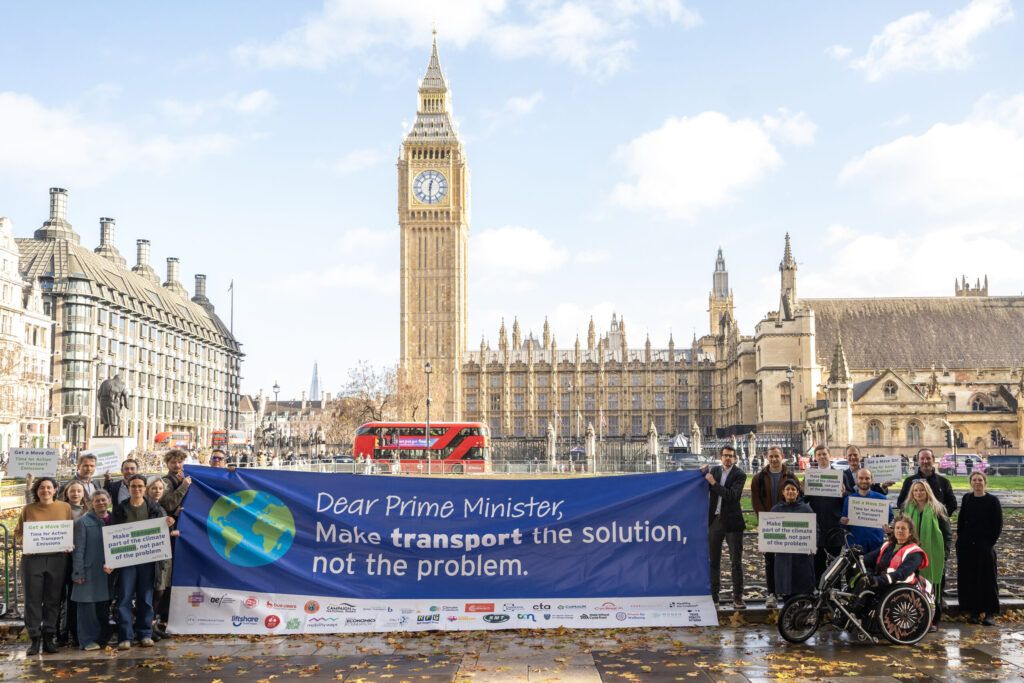
50 organisations and academics from across the transport, environmental, climate, health and civic sectors have urged the Prime Minister Andy Burnham to maintain a “strong and predictable” ZEV Mandate and to set out a “more ambitious plan” for tackling transport emissions.
In a letter co-ordinated by the Campaign for Better Transport to Burnham, the organisations warned that weakening one of the UK’s most important transport decarbonisation policies would jeopardise progress towards the country’s climate goals at a time when transport remains the country’s largest source of greenhouse gas emissions.
It follows a warning from the Climate Change Committee to the Transport Secretary that weakening the ZEV Mandate would put the UK Government’s commitment to tackling climate change at risk.
Transport is now the largest source of carbon emissions in the UK economy, but transport emissions rose by 2% last year, driven largely by increased use of petrol and diesel vehicles on the roads.
The coalition behind the letter is calling on the UK Government to set out a credible plan to cut transport emissions year on year and accelerate the shift to cleaner, more sustainable forms of travel.
It calls for:
- Maintain the Zero Emission Vehicle mandate, providing the certainty manufacturers, investors and the wider supply chain need to accelerate the transition to electric vehicles.
- Set a clear, measurable plan to reduce transport emissions, with annual targets, transparent reporting and aligned investment.
- Set overarching national targets for increasing the journeys people choose to make by sustainable transport, building on those in place for active travel, and report annually on progress.
- Prioritise investment in accessible public transport, shared mobility, community transport and active travel.
- Fast-track car club and car-sharing strategies to reduce congestion and lower household transport costs.
- Support rail freight and passenger rail as essential tools for cutting emissions.
- Better align national carbon reduction plans with local transport and climate objectives.
Ben Plowden, Chief Executive of Campaign for Better Transport, which coordinated the letter said:
“The Prime Minister has acknowledged that climate change is no longer a future threat. Communities across the UK are experiencing its impacts now, from extreme weather to rising costs and disruption.
‘The Government is right to support the transition to electric vehicles. Weakening the ZEV mandate would make one of our most important climate policies significantly less effective. We understand the challenge facing the auto industry and the need for a clear path to a decarbonised transport system, but if we are serious about meeting our climate commitments, we should be increasing ambition, not lowering it.
“At the same time, there is no single solution to reducing transport emissions. Alongside electrification, we need sustained investment in better public transport, more opportunities for car sharing, and safer routes for walking, wheeling and cycling.
“The breadth of organisations backing this letter shows the strength of support for a cleaner, healthier and more affordable transport system. We know what works. What is needed now is a clear plan and the political will to deliver it.”
Hugh Montgomery OBE, Professor of Intensive Care Medicine at the University College London and Chair of UK Health Alliance on Climate Change, said:
“Tailpipe emissions poison people and planet. Sustaining the pace of change on electric vehicles is an opportunity to address both, reducing harmful air pollution while cutting the emissions driving climate change. Weakening the ZEV mandate would risk slowing that progress at a time when we need to be moving faster, not slower. The ZEV mandate shows that government energy transition timetables are to be trusted, giving businesses, investors and the public confidence that the shift to cleaner transport will stay on course.”
Isaac Beevor, Partnerships Director at Climate Emergency UK, said:
“Delaying the ZEV mandate would confirm that many councils’ net zero targets are threatened or out of reach. Some councils have been trying their hardest and, as shown in our Scorecards, have been working with charging operators to quickly install publicly available electric vehicle chargers. To have their efforts undermined by the national government would be devastating.”
Sarah Sleet, CEO of Asthma + Lung UK, said:
“The Prime Minister pledged at COP that the UK would play its ‘full part’ in tackling the climate crisis. Yet at home, his government is considering weakening one of its most important transport decarbonisation policies. We know air pollution kills, with up to 43,000 premature deaths every year, and road transport remains the leading source of toxic NO2 emissions in the UK. Any slowing down in rate of change to achieve the ZEV mandate exposes more people to the suffocating grip of air pollution and puts the government’s legal commitment to net zero by 2050 at risk.”
Anna Filby, Founder & CEO of Young Mobility Network, said:
“Young people and the next generation of mobility professionals are working hard to build a transport system that is more accessible, inclusive and sustainable. Through our community, we see the passion and commitment of those driving this change and working to ensure that transport better serves everyone, regardless of their background, income or location. Weakening the ZEV mandate would risk undermining progress, but it would also highlight why we need a broader, long-term vision for mobility – one that combines cleaner vehicles with accessible public transport and affordable, inclusive travel choices. The next generation is ready to help deliver that future, but it needs consistent ambition and commitment from Government to turn that vision into reality.”
Steve Brooks, Director of External Affairs for Cycling UK, said:
“Whilst transport emissions remain stubbornly high, households across Britain are struggling to pay for everyday travel costs. The Prime Minister has an opportunity to kill two birds with one stone by investing in safer routes for walking and cycling, alongside better, more affordable buses. It’s a practical way to cut emissions, ease pressure on family budgets and give people more choice about how they travel.”
Richard Dilks, chief executive of CoMoUK, said:
“Car clubs can make a major contribution to the switch to electric vehicles. For the third of households without a driveway, a shared EV is often the most practical way to go electric, and it lets people drive one without the cost of buying it. But car clubs are being held back by barriers the government could remove. The ZEV Mandate’s preference for car clubs has sadly not delivered so far and needs review. Car club vehicles rely on public chargers, which cost far more per mile than charging at home, and carry 20 per cent VAT. Paying to charge at public chargepoints is still too patchy and complicated, with operators juggling different apps, accounts and tariffs across different networks.
“If ministers want the transition to succeed, they need to fix the tax treatment of shared EVs, bring down the cost of public charging, take effective steps to lower the cost of EVs for car clubs, extend any future discount schemes to include car clubs, work collaboratively to encourage fleet use of shared EVs and make paying for charging simple.”
The letter is signed by: Campaign for Better Transport; ASLEF; Asthma and Lung UK; Aviation Environment Federation; Bus Users UK; Campaign against Climate Change; Campaign for National Parks; Campaign to Electrify Britain’s Railways; Clean Cities; ClientEarth; Climate Catalyst; Climate Emergency UK; Climate Outreach; Community Rail Network; Community Transport Association; CoMoUK; Cycling UK; Freewheeling; Friends of the Earth; Global Action Plan; Good Journey; Green Alliance; Greener Vision; Healthy Air Coalition; Imperial College London; JFG Comms; Liftshare.com Ltd; Living Streets; London Cycling Campaign; Mobilityways Ltd; Modeshift; Mums for Lungs; New Economics Foundation; PACTS; Partnership for Active Travel, Transport and Health; Possible; Rail Forum; Rail Freight Group; Riding Sunbeams; RMT; Royal College of Physicians; T&E UK; Transport Action Network; UK100; UK Health Alliance on Climate Change; University of Leeds; Walk Wheel Cycle Trust; Wheels for Wellbeing; Women in Transport; Young Mobility Network UG.