Building the workforce for tomorrow will require employers to make time for mentoring, support continuous training and turn strong interest in transport careers into workplace opportunities, the Transport + Energy Forum has heard.
In a discussion, entitled ‘Transport + Energy Skills: Building the workforce for tomorrow’, they explored how the sector can move from identifying its skills needs to delivering the people and capabilities required.
Opening the session, Ben Silverstone, Associate Professor, Head of Skills Policy and Strategy, WMG, said the focus needed to shift towards implementation.
“We spent too long talking about what, not enough about when, where, how,” said Silverstone.
He also urged organisations to distinguish between a shortage of people with existing skills and a gap in the capabilities needed for new technologies. Each required a different response, with increasing training capacity only part of the answer.
Darren Shaw, Head of Construction, Built Environment and Transport, Skills England, explained how occupational standards underpin apprenticeships and define the competence required for particular roles. He said Skills England had completed the first phase of its Skills for Work consultation, gathering employers’ views on what was working, what was missing and where standards needed to change.
That evidence would help inform the next stages of work alongside sector jobs plans, he suggested. Shaw also highlighted Skills England’s role in bringing together intelligence that could otherwise be fragmented across government departments.
However, the discussion heard that better planning must be matched by employers’ ability to develop people in the workplace.
Hayley Pells, Government Affairs Lead, The Institute of the Motor Industry (IMI), warned that falling advertised vacancies did not necessarily mean recruitment pressures were easing.
In some cases, businesses had stopped advertising because recruitment had become so difficult, instead placing greater demands on their existing teams.
Pressure on experienced technicians was also reducing the time available to mentor new entrants, threatening the supply of future skilled workers.
“So we’ve got that shortage at the top, we’ve got that squeeze in the middle, and then we have got demand of people wanting to come into the industry, but they’re not getting that mentoring or that experience coming down to them either,” she said.
Silverstone said research into declining engineering apprenticeships had included employers receiving 1,000 applicants for a single apprenticeship place, illustrating the difficulty of converting interest into opportunities.
Pells pointed to the time pressures facing businesses and an inclination to recruit existing skills rather than develop their own people.
“Work-based learning can only happen if the workplace exists to learn it,” she said.
Shaw stressed that employers were central to making apprenticeships work, with training forming part of a real job, saying: “The apprenticeship system therefore cannot work without the employer”.
Alongside attracting new entrants, the panel considered how to support the existing workforce as electrification and connected technologies change the demands of vehicle maintenance and repair.
Pells said training needed to reflect both emerging technology and the work technicians were encountering. Providing skills too far ahead of demand could leave individuals without opportunities to apply them.
“It’s not just by qualification alone that we can skill the workforce,” said Pells. “It is that CPD, that professional recognition, and that demonstration of competence that I think employers need and motorists need — that safe transition.”
She also challenged the suggestion that employers were unwilling to invest, arguing that financial and operational pressures limited their capacity.
Pells suggested exploring tax incentives for short, stackable, modular courses to support retraining, returning workers and existing employees.
The session closed with a call for businesses and individuals to help shape skills provision, engage with professional bodies and be clearer about the problem they needed to solve.
“Let’s be explicit. Is it about the shortage, or is it about a genuine capability gap?” concluded Silverstone. “Do you need more of the same or something different?”
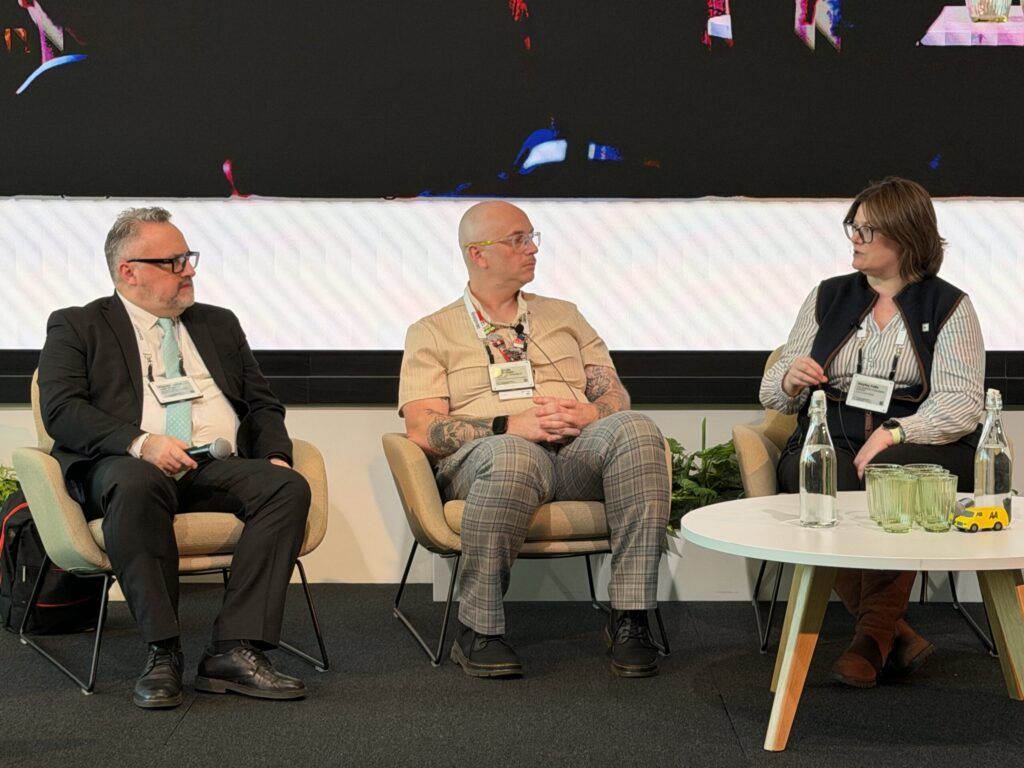
Photo, left to right: Darren Shaw, Ben Silverstone, Hayley Pells.