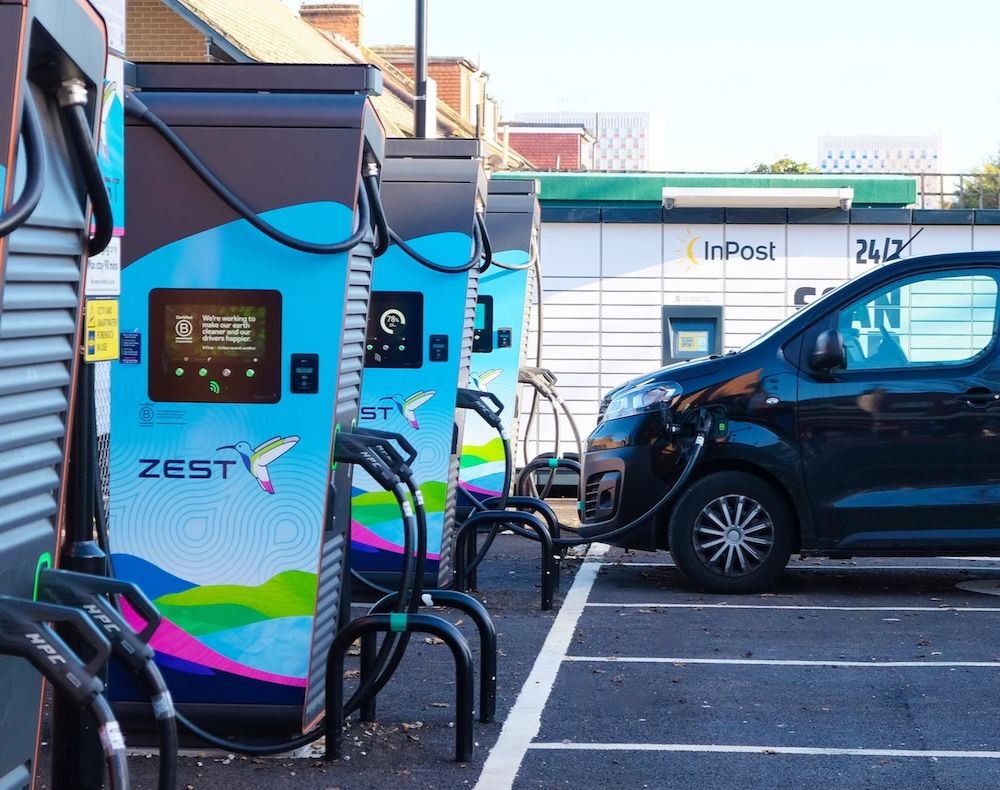
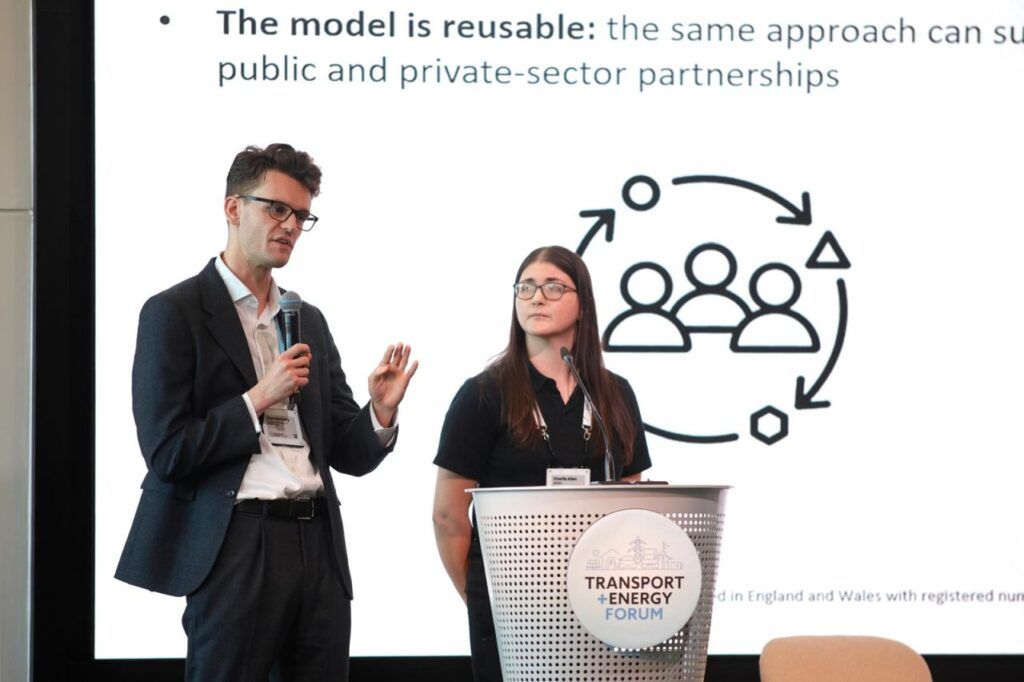
The T+E Forum heard a detailed case study on the partnership between Believ, Uber and the London Borough of Redbridge which delivered 86 operational EV charging sites.
The project demonstrating how private sector funding, demand data and long-term collaboration can support the expansion of public charging infrastructure.
The London Borough of Redbridge has recorded almost 18,000 EV charging sessions in just three months, highlighting the growing demand for public charging infrastructure and the potential of private sector partnerships to accelerate network deployment.
Speaking about the project, Liam McCorry of the London Borough of Redbridge and Charlie Allen of Believ outlined how collaboration with Uber helped deliver the network, which now comprises 86 operational sites across the borough.
Unconventional funding
The project took an unconventional approach to funding, with private sector investment replacing the more traditional reliance on government funding. Uber provided financial support, alongside the charge point operators involved in the programme, meaning there was no cost to the participating councils.
However, getting the project underway was not straightforward. McCorry explained that the council initially faced challenges around accepting private sector funding and navigating the procurement process.
Using the Public Contracts Regulations 2015 (PCR 2015) and a competitive Dynamic Purchasing System, the project took approximately three years from inception to delivery.
Despite the lengthy process, the partners believe the model provides a valuable example of how local authorities can work with private companies to fund and deliver public charging infrastructure.
Data-led approach
A key element of the programme was Uber’s contribution of anonymised data showing where its drivers were operating and requesting charging facilities. This helped identify areas of genuine demand, supporting councils in selecting locations while giving charge point operators a clearer understanding of where infrastructure would be most beneficial.
Allen said the data was “particularly valuable” because “high-mileage drivers could make significant use of the network, helping demonstrate the commercial case for investment”.
The network currently includes a mixture of two-bay and four-bay charging sites. Of the 86 operational locations, 59 also have passive infrastructure installed, meaning ducting, cabling and power connections are already in place, ready for additional charge points to be activated as demand increases.
The approach allows the council and its partners to expand capacity without immediately installing the maximum number of charge points at every location.
Allen highlighted the importance of agreeing clear activation criteria between councils and charge point operators. These could be based on utilisation levels or requests from residents and drivers.
He also stressed that “activating passive infrastructure still requires funding approval” and, where additional bays need to become enforceable, further Traffic Regulation Order (TRO) or Traffic Management Order (TMO) processes may be necessary.
Site selection
Site selection has also played an important role in the project’s performance. McCorry highlighted one road as one of the network’s strongest-performing locations. Situated in a densely populated residential area, the site benefits from a long stretch of kerbside parking outside a church, providing space for charging infrastructure without placing it directly outside residents’ homes.
Another installation required a different approach, with a build-out into the carriageway to accommodate charge points outside a block of flats where the pavement was particularly narrow.
McCorry said these examples demonstrated the importance of adapting installations to local conditions and considering the surrounding community during the planning and consultation process.
He also emphasised the value of securing councillor support and communicating clearly with residents that the charging bays are publicly available, rather than reserved exclusively for Uber drivers.
The network’s performance provides evidence of the demand underpinning the investment. Between July and September, Redbridge recorded almost 18,000 charging sessions involving approximately 1,400 unique drivers. These sessions represented around 1.85 million miles.
For Allen, the figures demonstrate what can be achieved when charging infrastructure is reliable, accessible and located where drivers need it.
He said monitoring performance at individual sites was essential, allowing partners to identify successful locations, address underperforming areas and determine where passive infrastructure should be activated.
Sharing data
Both speakers also highlighted the importance of data sharing beyond the initial procurement process. While Uber’s driver data helped establish demand at the outset, ongoing network utilisation figures and resident requests will be increasingly important as EV adoption grows.
They believe this information will help councils make better-informed decisions about future expansion and support their next procurement exercises, particularly as the Local Electric Vehicle Infrastructure (LEVI) programme eventually comes to an end.
Reflecting on the project’s lessons, McCorry identified three priorities for other local authorities: agreeing partnership terms early, building infrastructure where demand has been demonstrated, and continually measuring performance to inform future expansion.
With agreements potentially lasting around 15 years, both speakers stressed that successful delivery depends on more than securing initial funding.