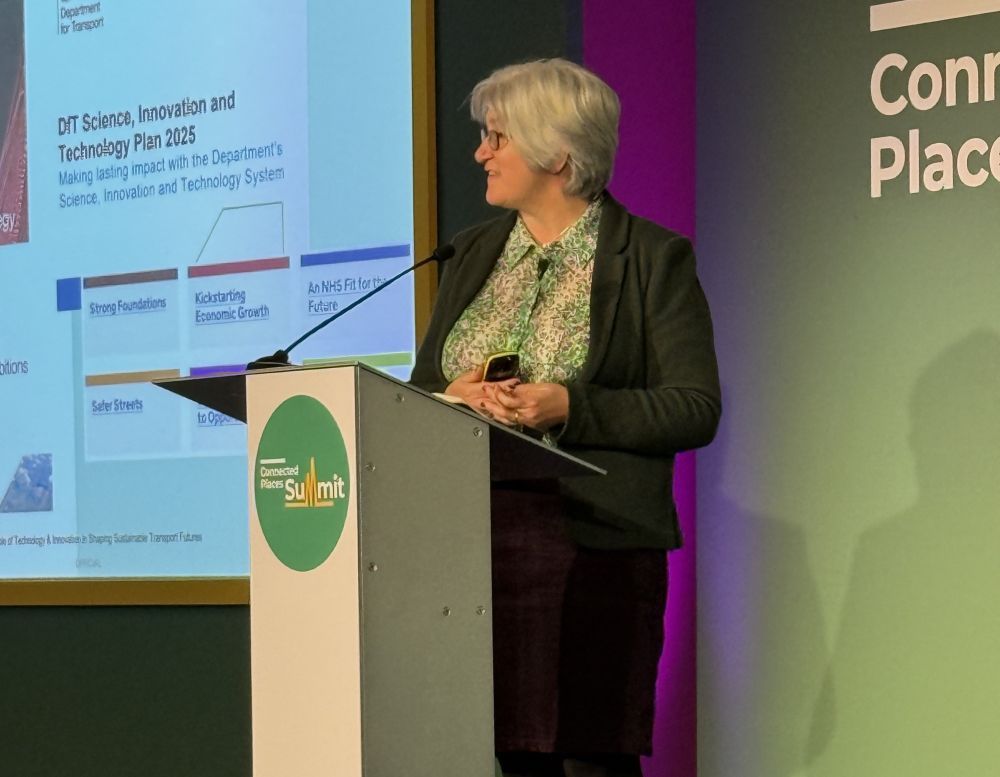
The sharing of innovation is vital in order for the UK to decarbonise transport, Chief Scientific Advisor of the Department for Transport, Professor Patricia Thornley, told the Connected Places Summit.
Thornley said the challenge of decarbonising transport was “absolutely vast” and the UK is currently not near to its goals – highlighting how the sector was still a large emitter of carbon emissions.
But she added that it was “government’s job” to put in place targets to meet goals, and to work with the industry to find the solutions possible to reach targets.
She said that new technologies were “going to make a huge difference” in people’s lives, and, since being appointed Chief Scientific Advisor, she had realised that the Industrial Strategy was a key driver in government and “driving an awful lot of thinking”.
It was through “simple” but “really effective” solutions that change can happen, Thornley added, highlighting projects such as Aeroflow’s collapsing freight containers, which reduced drag for trucks when not carrying goods, as a cheap but effective way to reduce emissions.
She said that some of the most effective solutions for transport were often “unseen” and the best innovations were “practically invisible”. Therefore, she called on industry to share its examples and evidence bases with the Department for Transport in order to move forward with schemes and projects that make a difference.
The comments were echoed by managing director of transport at the Connected Places Catapult, Sameer Savani, who said that although transport was “absolutely embedded” in the Industrial Strategy, “we must do better” in ambitions to decarbonise the sector.
He added that this could be achieved by moving beyond constantly reproving innovations and pilot stages, and accelerating through ensuring that “brilliant technology” is scaled up – something which the Catapult was aiming to achieve through innovation passports.
Earlier in the summit, CEO of the Connected Places Catapult, Erika Lewis, opened the event by outlining how with “collaboration and bold ideas” we can build infrastructure fit for the future and for people to “live longer, healthier lives”.
She highlighted how if just 1% of the government’s £725bn infrastructure fund was spent on innovation, it would unlock potentially 600,000 new jobs.
In addition, she did a shout out for the firms already making a difference, such as Tom Heenan of EV battery firm Gaussion or Michael Gibson and Fuuse, which has doubled its turnover in two years.