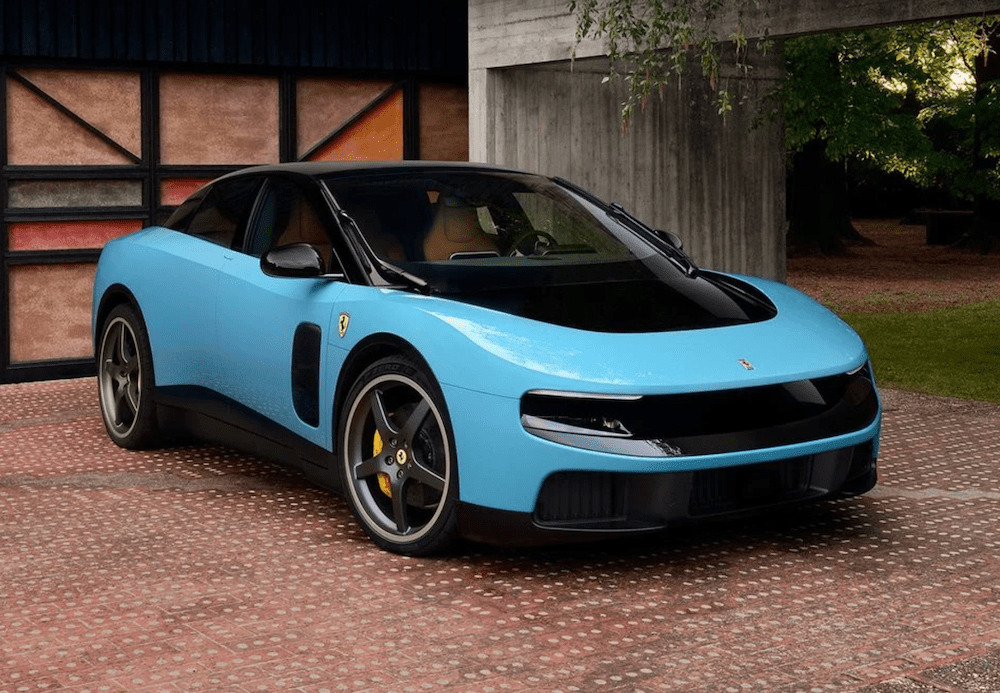
Sports car manufacturer Ferrari has launched its first fully electric vehicle (EV) as part of a “multi-energy strategy”.
The Luce EV has been aligned with Ferrari’s principles of engineering, developing and manufacturing all of the main components in-house, including the electric engines and battery pack.
As a result, the project resulted in more than 60 new patents, and ensured long-term value by the manufacturer stating it would provide assistance on all electric components, including batteries, in the future.
The OEM, famous for its big internal combustion engines, made the move under its principle of technological neutrality, with electrification being described as “just one of the means available to Ferrari to expand its design potential in product architecture, performance, design, and driving experience, without replacing existing engines”.
It was designed by LoveFrom, a design collective led by Sir Jony Ive, who was responsible for the iPod and the iPhone, and Marc Newson.
The Luce is the first Ferrari to have four doors and five seats, and is built on a bespoke platform with a dedicated chassis and engineering innovations “in every single component”, the company claimed.
Kerb weight is 2260kg, delivering 0-62mph in less than 2.5 seconds, a top speed over 192mph, and a maximum total power output of 1050cv. It has a range of more than 329 miles, with power from four electric engines, one per wheel, and a 122kWh battery.
The high-voltage battery pack was designed, validated, and built in Maranello and comprises 210 cells in series that deliver the 122 kWh and support fast charging up to 350 kW. It is designed as a structural element of the car. Power electronics feature compact inverters and a DC/DC resonant converter for the active suspension to achieve efficiency of more than 98%.
An interesting innovation on the car, and relating to a recent story on researching “thrilling” driving, is Ferrari’s approach to sound.
A precision accelerometer at the centre of the axle captures the dynamic texture and vibration of the rotating components while the sound waves are moving. Developed in-house and patented, the system “filters, equalises and amplifies the signal in a similar way to an electric guitar, but only when functional to the driving experience”, it said.
Sound is emitted via an external amplification system that creates a natural sound wave, and an internal system that ensures detail and high fidelity. As well as the quality of the interior sound, this has the benefit of being audible outside the car, it said.
Also in terms of sustainable production, the use of recycled secondary-alloy aluminium allows a reduction in CO₂e emissions during production of around 70% of the overall vehicle weight.
Image courtesy of Ferrari