Analysis of MOT tests has found that high-mileage electric vehicles (EV) are less likely to fail the test than petrol equivalents.
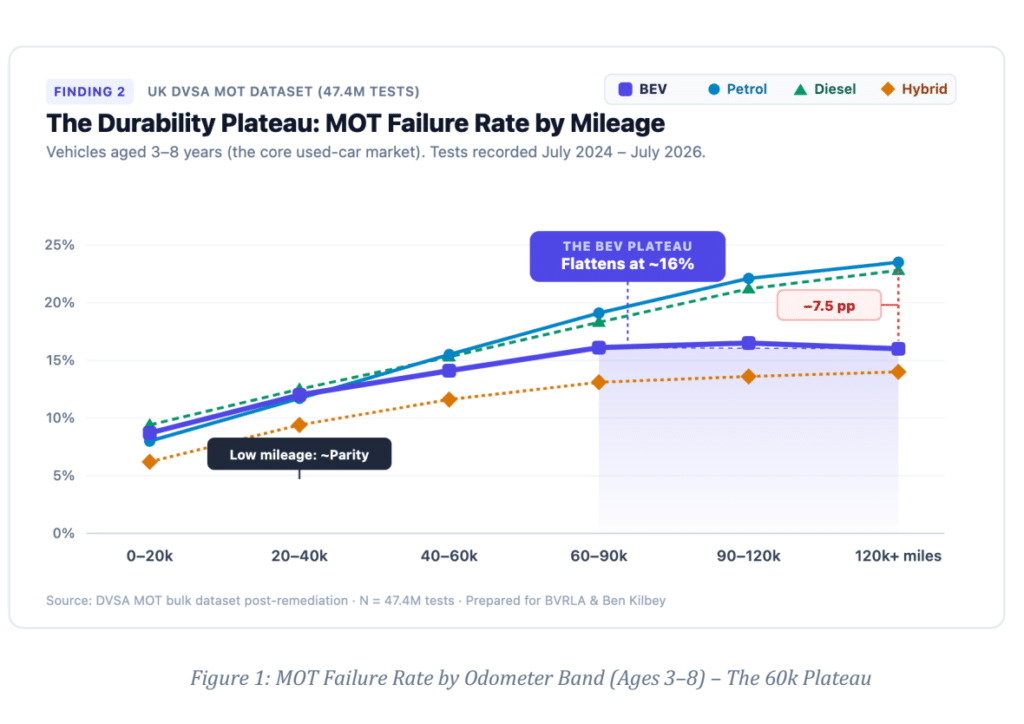
The study of 47.4 million tests, commissioned by the British Vehicle Rental and Leasing Association (BVRLA) and carried out by New AutoMotive, found from 60,000 miles there was a divergence in the success rate of passing between petrol vehicles and electric vehicles.
EVs levelled off at approximately 16%, while petrol and diesel failure rates continued climbing, and between 90,000 and 120,000 miles on the clock, 22.1% of petrol cars failed. Above 120,000 miles, the gap grows further, with a 16.0% failure rate for EVs compared with 23.5% for petrol.
The researchers also examined whether older electric cars appeared to be disappearing from Britain’s roads earlier than petrol vehicles. Tracking whether vehicles returned for a subsequent MOT within 30 months found that, at age 15, 94.6% of EVs returned compared with 88.1% of petrol cars.
There is an implied road-exit rate of 5.4% for EVs compared with 11.9% for petrol. EVs also recorded higher median annual mileage than petrol cars at every age examined between four and 16 years.
But the study also showed EVs recorded approximately 1.8 times as many tyre defects as petrol cars, although the analysis found the problem was particularly pronounced among some earlier EVs adapted from combustion-engine platforms.
Researchers found no equivalent ‘EV weight penalty’ for suspension components. Between 60,000 and 90,000 miles, electric cars recorded 4.7 suspension defects per 100 tests compared with 6.1 for petrol cars.
High-mileage EVs experienced substantially fewer brake defects, but older, low-mileage EV showed increased friction-brake defects, which the researchers attribute to corrosion associated with the physical brakes being used less frequently.
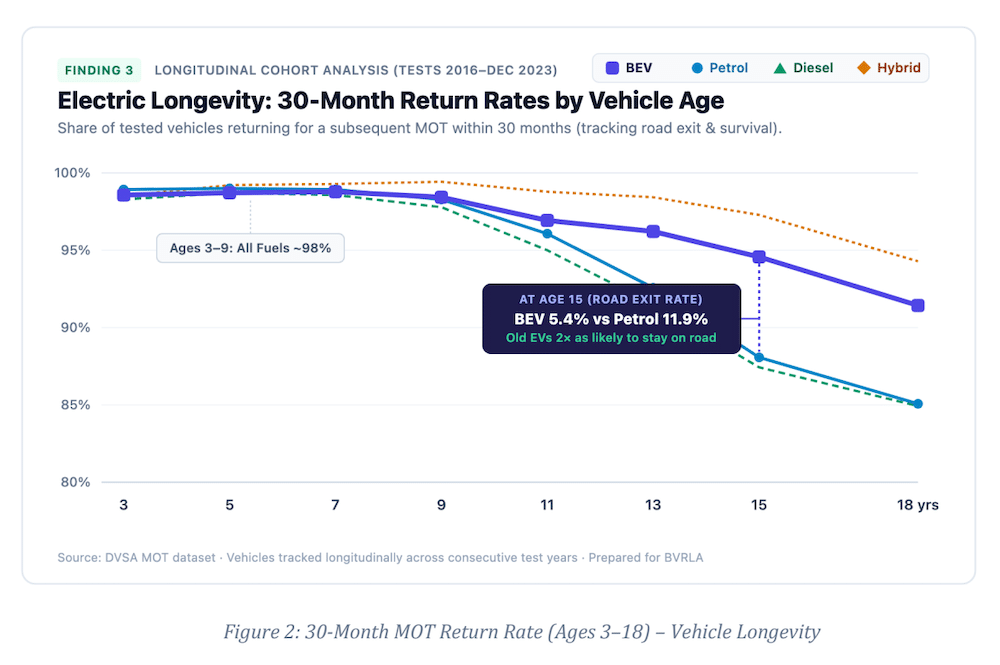
Hybrid cars also performed strongly in the analysis and in several categories recorded lower MOT failure rates than either petrol cars or BEVs.
Toby Poston, Chief Executive of the BVRLA, said:
“Mileage has always been one of the first things people look at when buying a used car, and passing 60,000 or 70,000 miles can have a big impact on how a vehicle is perceived. This research suggests we need to think differently when it comes to electric vehicles.
“Many of the EVs now entering the used market have had their first life in company and leasing fleets and have already covered substantial mileage. What this data shows is that mileage alone should not put consumers off. A well-maintained, higher-mileage electric car can be an extremely durable used vehicle.
“That matters because the used market is where the transition to electric becomes accessible to millions more motorists. Giving buyers confidence in these cars will be critical to creating a healthy and affordable second-hand EV market.”
Ben Nelmes, Chief Executive of New AutoMotive, which carried out the research, said:
“The important thing about this study is that we can separate age from mileage. Looking simply at the headline MOT numbers gives a misleading picture because Britain’s electric cars are much younger than its petrol and diesel fleet, while comparing cars by age alone misses the fact that EVs have typically covered considerably more miles.
“Once we compare cars of the same age and mileage, something striking happens. At lower mileages there is very little between petrol and electric cars, but beyond around 60,000 miles the failure rate for EVs flattens while the petrol failure rate continues to rise.
“That is powerful evidence for anyone considering a used EV. High mileage isn’t a proxy for poor condition in the way buyers have traditionally assumed. The data suggests the mechanical simplicity of an electric drivetrain starts to become increasingly valuable as cars accumulate miles.”
“This isn’t an argument for buying a used EV without doing your homework. Buyers should look at its history, condition, tyres and battery health just as they would scrutinise the engine, gearbox and service history of a petrol or diesel car.
“What we can now challenge is the idea that an electric car with 80,000 or 100,000 miles on the clock should automatically be regarded as worn out. The evidence simply doesn’t support that assumption.”
Image courtesy of Green Car Guide