New research from Vauxhall has revealed that while the number of councils providing accessible on-street EV charging has doubled in the last year, three quarters still have no chargers specifically adapted for drivers with accessibility needs or that meet recognised accessibility standards.
In the exclusive new Freedom of Information (FOI) research, 49 of the 194 councils who responded to Vauxhall said they now have on-street charge points that have either been specifically adapted for disabled drivers or conform to the British Standards Institution’s PAS 1899:2022 accessible charging standard. This compares with 24 councils in 2025.
The new findings follow Freedom of Information (FOI) research conducted by Vauxhall in 2024 and 2025 into the accessibility of on-street charging for drivers across the UK.
Compared with previous years, the latest research suggests progress is being made. The number of on-street EV chargers located within disabled parking bays has more than doubled since 2024, rising from 105 to 245. An estimated 15% of on-street chargers are now specifically adapted for disabled drivers, while 14% conform to PAS 1899:2022 accessibility guidance.
However, the findings show there is more work to do to ensure public charging is accessible for all drivers. While more than half of councils who responded to Vauxhall’s FOI saying their charging strategies include considerations for disabled and elderly residents, accessible charging provision remains uneven across the UK. Vauxhall’s found just 43 accessible on-street chargers in the North West and 14 in Scotland, compared with 2,131 in London.
Eurig Druce, Managing Director, Vauxhall & Group Managing Director, Stellantis UK, said:
“It’s encouraging to see the number of councils providing accessible on-street charging nearly double in the last year. This shows growing recognition of the importance of ensuring disabled drivers can access public charging infrastructure.
“However, our latest research shows there is still more work to do. Three quarters of councils still do not provide chargers that are specifically adapted for disabled drivers or conform to recognised accessibility standards. As more drivers make the switch to electric vehicles, we need to ensure all motorists can easily find and access charge points if we are to bring everyone on the UK’s electrification journey.
“Through Electric Streets of Britain, Vauxhall is continuing to encourage drivers to register their need for on-street charging near them, and for disabled drivers to highlight where accessible charging is required. As the number of on-street chargers continues to grow, we want to see accessibility considered as standard so that going electric remains a practical and viable option for all drivers.”
The research forms part of Vauxhall’s ongoing Electric Streets of Britain campaign, which aims to support the millions of UK households without access to off-street parking. As more drivers switch to electric vehicles, accessible public charging will play an important role in ensuring disabled motorists can make the transition with confidence.
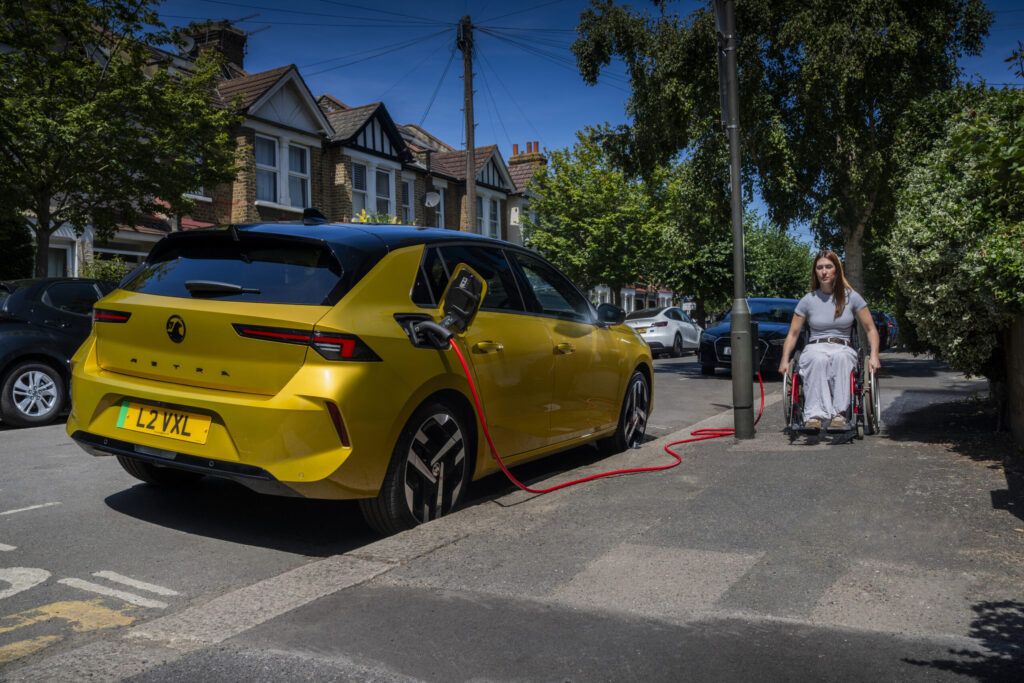
Earlier this year, Vauxhall welcomed Kerbo Charge as an Electric Street partner to raise awareness of cross-pavement charging solutions. While 7% of councils still allow unsafe cable covers, cross pavement charging creates a channel for the cable to fit in, keeping the pavement clear of obstacles for pedestrians and wheelchair users. By the end of 2026, 42% of councils will have cross-pavement charging available allowing more drivers access to affordable EV charging.
Motorists can register their need for on-street residential EV charging at electricstreets.co.uk, with more than 12,500 streets already nominated – within which over 500 drivers have told Vauxhall they require disabled access off-street parking. Vauxhall continues to share this data with councils to help inform future charging strategies.
Vauxhall is a founding member of the Motability Scheme and has worked closely with the Motability Foundation and Motability Operations, the organisation who delivers the Motability Scheme, since it was founded in 1977. The Motability Scheme enables disabled people to lease a vehicle.
Image courtesy of Vauxhall.