
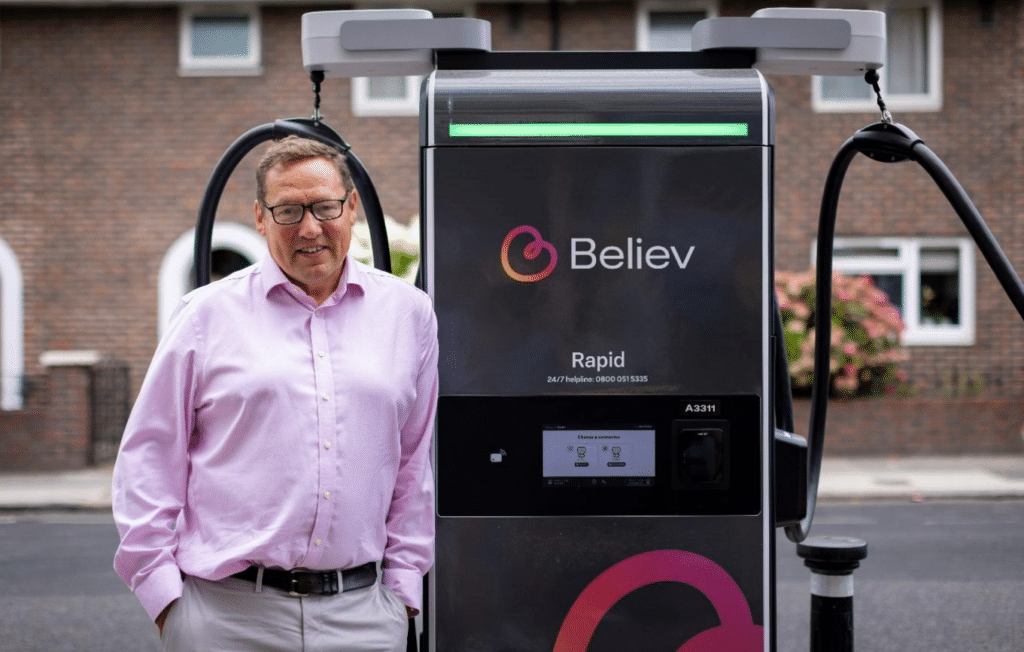
Guy Bartlett, the Believ of CEO, explains how the charge point operator’s work in the London Borough of Tower Hamlets offers a useful experience of the challenges around public charging.
With more than 124,000 public chargers live across the UK, the transition to electric vehicles (EVs) is gathering momentum. But as we scale infrastructure to serve mass adoption, and to deliver the confidence drivers require to make the switch, people need to be able to charge where they live, work and travel, and not just on a private driveway. Public charging is especially important in dense urban areas, where many residents park on the street and cannot install a private charger.
Indeed, for drivers without off-street parking, public charging is essential to the feasibility of choosing an electric vehicle. Put another way, if access to EV charging depends on having a driveway, the transition risks being shaped by housing type rather than people’s willingness to make the switch.
The London Borough of Tower Hamlets brings this challenge into sharp focus. The borough has limited street space, competing demands on its roads, a high number of commuters passing through and parking and, according to the RAC, the highest proportion of residents in the UK without driveways: 93% of homes are without off-street parking. With such a strong reliance on the public network, a successful charging network cannot be planned simply by identifying available pavement or installing equipment wherever a connection appears possible. Instead, it needs to respond to how people use the area, and to the practical constraints of installing charging infrastructure.
Start with the people in the borough
EV infrastructure planning should begin with the people a network needs to serve. Where do residents park? How do commuters move through the area? What charging speeds will be most useful for different users depending on dwell times and user journeys? And which locations are likely to work for these different charging needs? These questions help councils and charge point operators (CPOs) make better choices about where infrastructure belongs and what role each site should play.
Not every location can meet every need, rather a network may need different charging speeds in different places. Tower Hamlets is a useful example of rapid and ultra-rapid charging working alongside slower speeds. The network serves both the needs of residents utilising long-stay or overnight charging, commuters or commercial drivers requiring faster top ups.
The number of chargers installed matters, but so does the accessibility of a site and whether it is practical and suited to the needs identified in planning. A combination of local knowledge and operational experience should inform those decisions from the outset.
Bay management and community engagement
While technical feasibility is a complex and multi-faceted aspect of installing EV charging infrastructure, it is only one part of delivery. On-street charging also needs a clear approach to parking and bay management. Where bays are intended for charging, enforcement helps ensure they remain available to drivers who need to use them, rather than being blocked by vehicles that are not charging.
In London, changes to parking arrangements are handled through Traffic Management Orders (TMOs), which can involve public consultation and a consideration of resident objections. The time and resource involved can affect how quickly sites progress, so TMOs need to be planned as part of delivery and not left as an administrative detail for the end.
This is one reason effective partnerships matter as councils bring knowledge of local priorities, parking patterns and the communities they serve. CPOs bring delivery experience and technical network expertise. Together, they can align local needs with practical charging infrastructure requirements.
Community engagement is part of effective EV infrastructure planning too, because charging has to make sense to the people it serves. On this year’s 9 September World EV Day, Believ offered free charging at Tower Hamlet’s Newby Place, where its team answered questions about EV charging and the local network. The offer was to help showcase the benefits of EV charging to residents, commuters, taxi drivers and local businesses. Newby Place was one of the first 22 live chargers in a wider programme of more than 70 chargers across 35 sites. Explaining to residents what is proposed and why – and listening to local questions – can help make planning more responsive. It is not a substitute for good planning, but it should sit alongside it.
Looking below the surface
The situation underground can determine whether a site that looks promising is actually viable. Before progressing an installation, it is important to understand the location, traffic flow and existing infrastructure, including underground services, cabling and substations.
At Believ, early feasibility work includes using NUAR (National Underground Asset Register) mapping to identify underground services and assess potential cable capacity. This helps establish what may be possible before designs progress, while reducing the risk of unnecessary excavation, road closures and disruption; issues that matter greatly in a dense borough where street space is already under pressure.
Grid planning also requires early coordination between CPOs, local authorities, independent distribution network operators (IDNOs) and the larger, more regional distribution network operators (DNOs) to understand connection options and technical requirements. Power constraints, planned works and harmonics testing – checking the impact chargers may have on the local electricity network – can all affect delivery, particularly for rapid and ultra-rapid charging. Involving the right partners early helps identify potential issues and plan around them before they can cause delays.
Connection offers also come with time limits and may need extending or revisiting if a project does not progress in time. Understanding these timescales and coordinating early can help avoid preventable delays and repeated work.
A practical route to inclusion
The lesson from Tower Hamlets is that the complexities that go hand in hand with dense urban area EV charging rollouts can be overcome with the right approach and planning. Planning must start with driver needs, technical feasibility must be explored early, and delivery processes must be understood by all parties and treated as part of the infrastructure challenge.
A practical first step for local authorities is to bring partners together early and assess both sides of a potential site: what users need and what the grid and existing services can support. This gives councils and CPOs a strong basis for a deliverable network that fits the borough.
Five years from now, progress should be judged not only by how many charge points have been installed, but by whether residents can rely on public charging as a realistic option, regardless of whether they have a driveway. That is what an inclusive transition should mean: infrastructure planned around the people who need it and delivered in a way that works for the communities it serves.
Image of Guy Bartlett, Believ CEO, at a new rapid charger site – White Horse Lane, Tower Hamlets