Government and businesses are being warned policy changes and delays risk undermining investment in the transition to zero-emission vehicles.
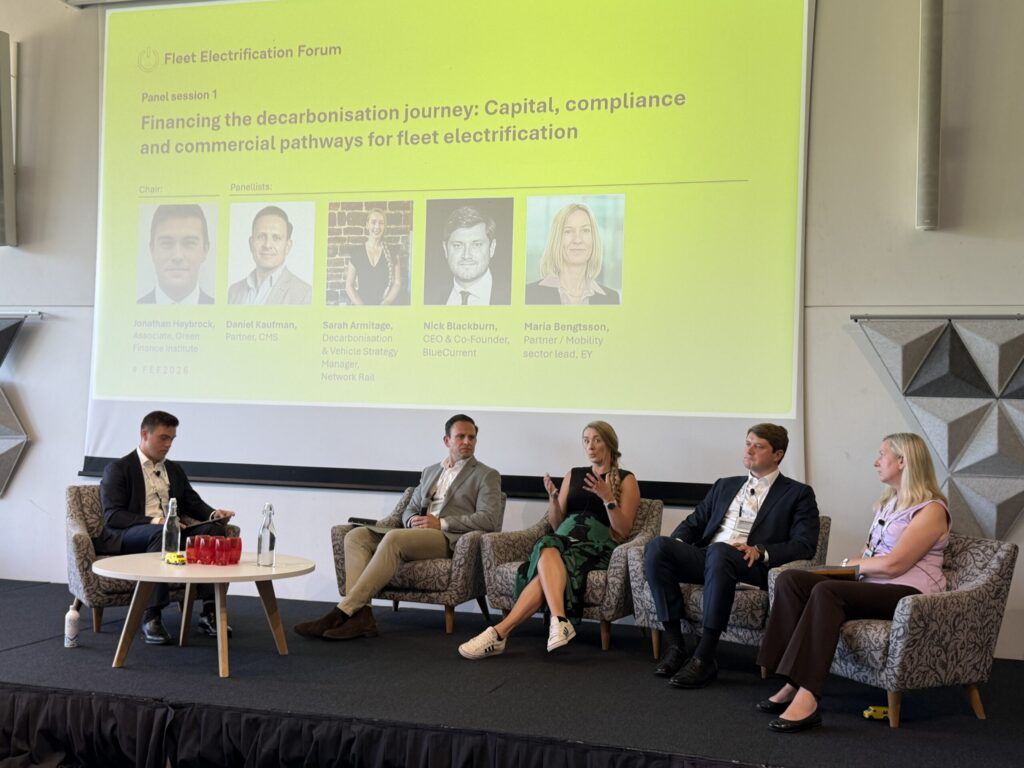
Speaking during a panel discussion on “Financing the decarbonisation journey: Capital, compliance and commercial pathways for fleet electrification” at the Fleet Electrification Forum in Warwick, experts from finance, legal, infrastructure and fleet operations agreed that confidence, careful planning and early engagement are essential if businesses are to unlock the commercial benefits of electrification.
Maria Bengtsson, Partner and Mobility Sector Lead at EY, said recent uncertainty surrounding government policy had made investors and fleet operators more cautious. She highlighted research showing that the postponement of the 2030 deadline for EV transition had prompted many businesses to pause or reconsider their electrification programmes, creating a risk that organisations fail to prepare for an inevitable transition.
“The danger is that people lose track of what the end goal is,” she warned, adding that companies should start planning now so they are ready when market conditions improve. She also argued that businesses need far more support in navigating the transition, saying: “I still think it’s too difficult. I still think it requires too much of companies to do their own research.”
Daniel Kaufman, Partner at CMS Cameron McKenna Nabarro Olswang LLP, said investors have largely accepted that short-term political uncertainty will continue and are instead concentrating on the long-term fundamentals of transport electrification. “What we’re hearing is real confidence in the end game being electrification, but it’s the pace of that transition that’s different,” he said.
The 200 delegates heard that, rather than relying on government mandates alone, investors are increasingly looking for secure, long-term revenue streams and financially robust fleet customers before committing capital.
Mr Kaufman also highlighted the importance of electricity procurement and future flexibility services in strengthening the business case for electric fleets. He said fleet operators should already be considering future opportunities around vehicle-to-grid technology because “it’s not far off.”
Nick Blackburn, CEO and Co-Founder of BlueCurrent, said his company continues investing in major charging hubs despite changing political conditions because commercial fleet electrification remains inevitable over the lifetime of the assets.
“We see it as a when, not an if question,” he said.
Mr Blackburn explained that securing electricity supplies early is fundamental to investment decisions. Obtaining confirmed grid connections before development begins provides greater certainty over costs and delivery times, allowing projects to proceed with confidence.
Grid capacity was also identified as one of the biggest practical challenges facing fleet operators.
Sarah Armitage, Decarbonisation and Vehicle Strategy Manager at Network Rail, said the organisation’s programme to electrify its fleet of around 10,000 vehicles depends on careful operational planning as well as financial modelling.
“The last thing we want is to roll EVs out in the wrong place, because negative word of mouth spreads way quicker than I can tell people that’s the best thing since sliced bread,” she said.
Network Rail is using telematics to identify which vehicles can be electrified first while also assessing whole-life costs including leasing, maintenance, downtime, charging infrastructure and energy.
However, Ms Armitage said one of the biggest hurdles remains providing enough power to hundreds of operational depots, many of which were never designed to support vehicle charging.
“We need quite a lot of DNO [Distribution Network Operator], which is obviously costly and time,” she said, referring to the distribution network upgrades required to provide sufficient electrical capacity.
Across the discussion, the panel agreed that successful electrification requires far more than choosing new vehicles. Businesses need fleet managers, finance teams, property specialists, HR departments and energy experts working together from the outset to develop integrated plans that consider vehicles, charging infrastructure, power procurement and operational flexibility.
The consensus from the panel was that although political debate may influence the speed of adoption, the destination remains clear. They agreed that the organisations that begin preparing now, rather than waiting for complete certainty, are likely to be best placed to benefit from the commercial and operational advantages of fleet electrification.
(Picture, L-R Jonathan Heybrock, Daniel Kaufman, Sarah Armitage, Nick Blackburn, Maria Bengtsson, credit Transport and Energy)