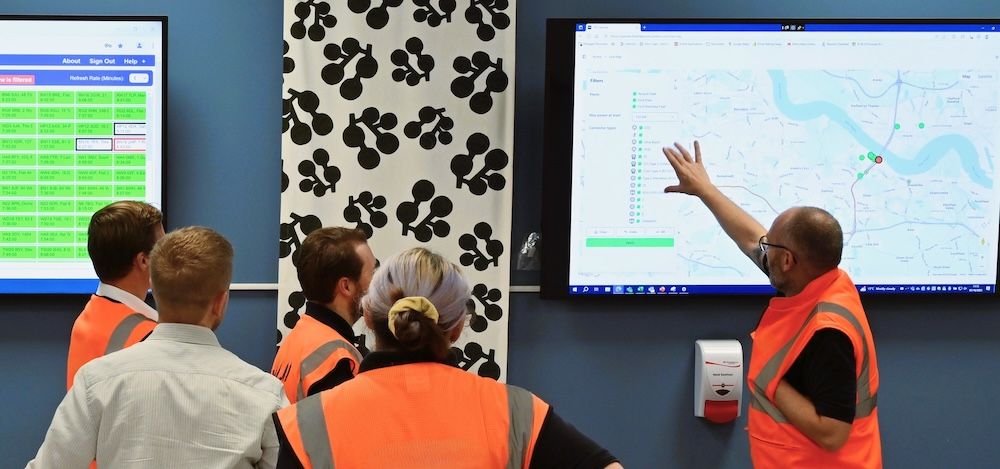
Anne Gray of Flexible Power Systems looks at the current state of play on the transition of fleets to decarbonisation.
Speaking at the SMMT Electrified conference in March 2026, Minister for Aviation, Maritime and Decarbonisation, Keir Mather said:
“The government is incredibly clear that the EV transition is something that we stand resolutely behind. … Is it ambitious? Yes, of course it is. And we as a government are committed to giving you the tools you need to make it happen.”
This ambition was revealed on 17 March 2026, when the Department for Transport hosted an industry event to showcase the ZEHID project achievements at the end of the funded phase on the planned deployment of approximately 300 zero-emission vehicles, and over 70 infrastructure sites by spring 2026.
Alongside the achievement and optimism on show, there was a level of anticipation in the room about further encouragement for the transport sector, and a sense that trade body lobbyists may have caught the ear of government.
Then on 25 March, the UK Government then announced a £1bn multi-year support package for commercial vehicle electrification, stretching to 2030. This was followed by Electric Freightway, the Gridserve-led ZEHID HGV demonstration project, issuing its final report from the set-up phase of its project.
Savings
Alongside positive driver attitudes and reality checks on route charging, heavy payload and electricity connection friction, its key conclusion was that the real-world operation modelling demonstrated when key factors are right, eHGVs can deliver genuine savings in excess of £100,000 over their lifetime operation when compared to equivalent diesel HGVs.
Fleet operators know that electrification is coming, with the government now seemingly demonstrating greater commitment to helping depot-based operators over the start line: purchase and infrastructure incentives have been renewed with a
greater degree of commitment than predecessor market-test schemes.
The hydrogen-orientated ZEHID trials have either foundered (HyHaul) or appear quiet (Zenfreight), indicating that electrification is now accepted as being the most rational route to net zero by 2035 (vans and HGVs to 26T) or 2040 (HGVs>26T) for the vast majority of use cases.
TCO
Commentators have tended towards polarised views on the matter of commercial vehicle decarbonisation. In more recent times, much of that commentary has tended towards HGV applications, given the funding and profile that the ZEHID programme has delivered. Quietly in the background, though, van electrification has geared up, with meaningful uptake grounded in positive business cases centred on, but extending far beyond, the Total Cost of Ownership (TCO).
And so, we return to the phrase “when key factors are right”. A more nuanced feasibility approach determines that TCO cost parity can be achieved on increasing numbers of LCV and HGV use cases, often necessarily with partial coverage of fleet operations initially, and small-scale pilot schemes the first important step.
It is also worth reflecting on early learnings from the Optimise Prime project that concluded in 2023. This pointed to profiled charging to “allow the accommodation of more demand on the network without reinforcements”, time-of-use tariffs, flexibility services and effective change management through active stakeholder engagement.
Even in 2023 there was clear evidence that energy mitigation mechanisms existed and that existing EV models could cover the typical daily range requirements of tested fleets, including depot-based and go-home. The fleet electrification guide for
commercial fleets helpfully outlined the key steps and technical requirements to successfully transition to an electric fleet – enabling fleets to accelerate their electrification plans.
Iran
The current US-Israeli military campaign against Iran has given rise to fuel price inflation consequences that hit at the heart of diesel-fuelled logistics operations in the UK and elsewhere, with fuel duty policy a further threat to operators.
Geopolitical factors and government incentives should inevitably encourage greater attention to non-fossil fuel alternatives, and fleet operators that have already adopted a considered approach to decarbonisation and financing structures will be in the box seat. The market is increasingly delivering diesel-parity financing options to derisk purchase decisions and cashflow pinch.
As fleet managers begin to manage a mix of traditional and electric vehicles, though, they face new challenges such as keeping site EV infrastructure online, optimising energy costs through improved scheduling and route planning, maximising uptime and managing payments from various charging locations. This necessitates adjustments to existing fleet management systems to ensure smooth operations and a viable overall business case where value shifts up the stack to energy optimisation, fleet orchestration and data control.
This requires a fleet-first, hardware agnostic, grid aware depot energy brain with tight Application Programming Interface (API) coupling between routes and energy, with platform-level software capable of handling depot load management, and fleet energy-fulfilment translation between vehicles-demand profiles/job allocation that delivers dispatchable assets for operations continuity and optimal efficiency.
Adaptation
Operations adapted for BEV can lead to substantial cost savings and efficiency gains, but EV adoption rates will vary significantly depending on factors such as region, industry/ fleet composition and organisational scale. This means that it is crucial to understand the underlying dynamics that can unlock opportunities for more sustainable and cost-efficient operations, whilst benefiting from available incentives.
Fleet operators should feel encouraged to prioritise and sequence transformation to achieve a sustainable, risk optimised route to a lower cost and high performing organisation.
Anne Gray, Corporate Development at Flexible Power Systems