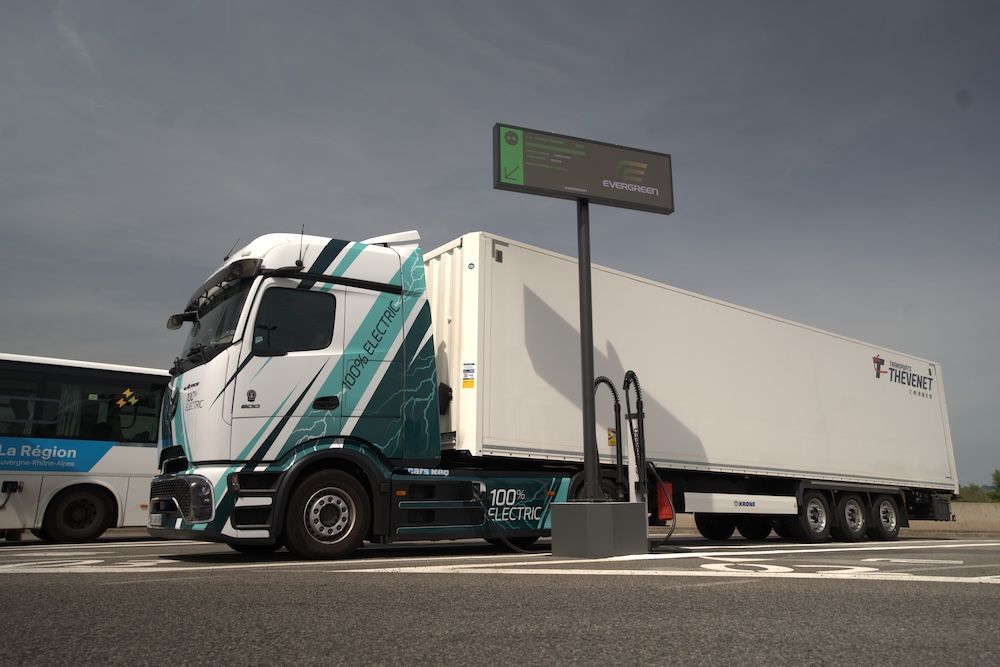

The cost of grid connections, electricity prices and financing are holding back the electric truck transition, according to a new report from the Aldersgate Group and the Renewable Energy Association (REA).
In the report, called ‘Ready to Move: a framework for decarbonising UK HGVs’, the organisations call for a single government transition plan built around three priorities: a clear long-term framework, finance that reduces risk for operators, and grid and charging infrastructure planned ahead of demand.
HGVs carry around 1.53 billion tonnes of goods around the UK in 2025, and account for around 17% of domestic transport greenhouse gas emissions – but only 0.3% of the fleet is zero-emission.
New SMMT figures show zero-emission trucks made up just 1.1% of new HGV registrations in the third quarter of 2026. But it comes as the average UK diesel price also passed £2 a litre for the first time in early October, according to the RAC.
As a result, the report recommends for the transition:
- A clear long-term framework, keeping the 2035 and 2040 phase-out dates, but publish a single transition roadmap with low carbon fuels for the short-term as zero-emission vehicles grow.
- Use the National Wealth Fund and British Business Bank to reduce risk on loans, assist smaller operators with electricity costs, and provide consistent battery information for lenders and second-hand buyers.
- Plan the infrastructure ahead of demand, with new logistic hubs and freight corridors connected ahead of time.
Rachel Solomon Williams, Executive Director at the Aldersgate Group, said:
“Record diesel prices have shown how exposed our supply chains are to fuel price shocks. Electric trucks are already delivering for British businesses, and the challenge is to make that possible for more operators. As government decides its next steps after the 2026 consultation on HGV decarbonisation, it has an opportunity to connect future regulation with affordable power, charging infrastructure and finance that reduces risk, which would cut emissions and make supply chains more resilient.”
Trevor Hutchings, Chief Executive at the REA, said:
“Freight needs to be part of energy planning now. Operators cannot invest confidently without knowing where charging will be available, when they can connect and what electricity will cost. Planning capacity ahead of demand, backing shared charging and battery storage, and clarifying the role of low carbon fuels in the interim would help more businesses make the move.”
Smaller hauliers face the greatest difficulties, because uncertainty about future resale values and battery condition raises the cost of borrowing and leasing. A grant can make a truck cheaper to buy, but it does not resolve the uncertainty that makes it expensive to finance, and depot charging may need significant grid investment before the first vehicle enters service.
Jamie Sands, Head of Solutions at Welch Group, said:
“We run battery-electric trucks in daily commercial service and they do the job. The vehicle isn’t what’s holding the sector back. It’s power and money. Connections take too long, electricity costs too much, and lenders can’t price a used electric truck because nobody can vouch for the battery. Sort the grid queue, cut power costs for HGV users and give finance a battery health standard it can underwrite, and smaller operators will follow.”
Nick Potter, Transport Director at Tesco, said:
“We are committed to becoming net zero across our own operations by 2035, and trialling and investing in electric trucks is part of our plans to achieve this. To further expand investment, we need an electricity supply and charging capacity we can rely on. We continue to support the Government on this work, while encouraging them to plan grid capacity around freight and make connections easier to secure.”
Image of report courtesy of Aldersgate Group/REA