A new pilot project in Finland aims to discover whether hydrogen and electricity can be used to power heavy-duty transport for long-haul journeys.
The scheme, led by VTT Technical Research Centre of Finland, sees the SISU Escalate truck, manufactured by Sisu Auto, run primarily on electricity, with a hydrogen fuel cells serving as an alternative power source for quick charging on long haul assignments. It includes a 650 kWh battery and fuel cell with a maximum power of 120 kW.
The truck will start normal transport operation in late 2026, and its journey will be continuously monitored and measured through vehicle data and a digital twin.
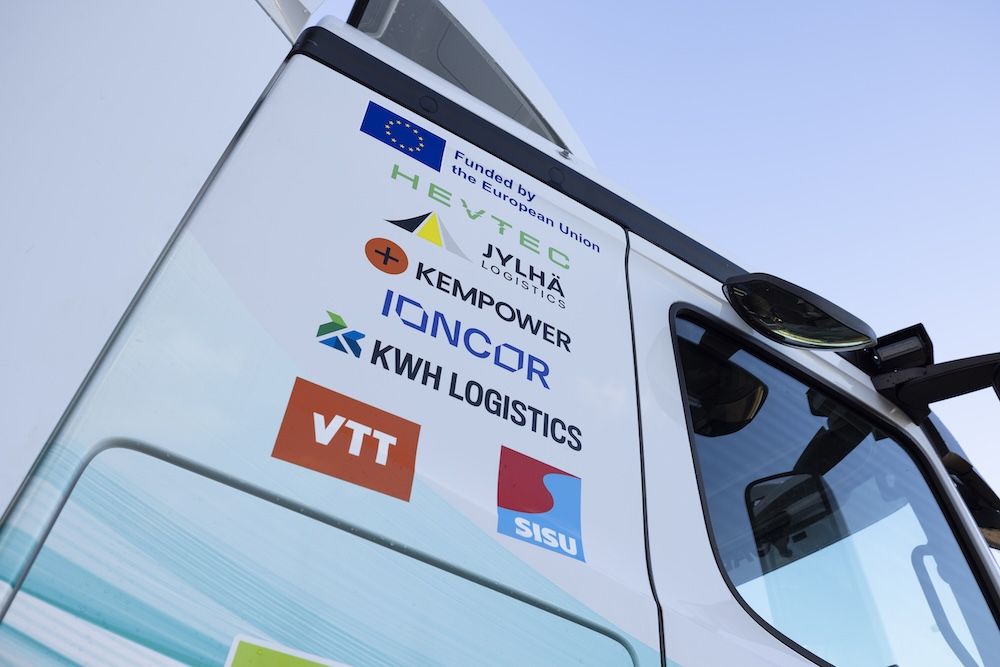
The project involves several partners from Finland, including Sisu Auto, a battery system from IONCOR, Kempower supplies the MCS charging infrastructure, and Hevtec responsible for the vehicle-side charging solution and the integration of the electric powertrain.
The truck will be operated by Jylhä Logistics between Vuosaari harbour in southern Finland and the city of Jyväskylä in central Finland, which includes a hydrogen fuel station. There are charging stations at both ends of the long haul route, and a megawatt scale charging station will be built along it.
The vehicle’s first, full-electric version was tested in spring 2026 by logistics company Rauanheimo.
The data will allow the pilot team to calculate the most economic ways of driving this kind of hybrid vehicle. Price data on hydrogen fuel and charging will enable the team to estimate how much energy should be loaded and where. The data is benchmarked against diesel-powered vehicles to assess cost benefits.
The pilot is part of the EU-funded ESCALATE project, which aims to prove that a zero-emission heavy vehicle can operate reliably in real-world driving conditions.
Mikko Pihlatie, Research Professor at VTT, said:
“The vehicle will drive 540 kilometres per day, during which we will monitor how much electricity and hydrogen it is using.”
“By monitoring the truck for six months, we will gain data about the vehicle’s performance, the ways different factors such as weather conditions impact consumption, and what limitations may occur in the operation of the vehicle. This information will help us develop the charging station network and optimise energy consumption.
“A total of four trucks are piloted across Europe in this project, with different structures and power sources. SISU Escalate is the heaviest and longest of these. With its size and the difficult winter conditions in Finland, the operating environment of this truck is the most demanding of the four.”
Petri Kananen, Head of Development at Sisu Auto, said:
“The SISU Escalate truck is not a product that will be launched in the market, but rather a means for testing the technology. With the learnings from the pilot, we can choose the best solutions for a product series developed for the market. The data will help us develop energy management systems and optimise driving with the battery to maximise the distance that can be driven with electricity. Hydrogen is, after all, the more expensive fuel.”
Juuso Kelkka, Senior Manager of Technology Development at IONCOR, said:
“Battery technology is a key element in the electrification of traffic. The pilot is carried out with a highly demanding setup: the modular battery platform must function in a 76-tonne articulated vehicle, in harsh winter conditions, and on a long-haul route. With this truck, we can prove that a lithium-ion battery is a viable solution even in these conditions.”
Image courtesy of VTT/SISU