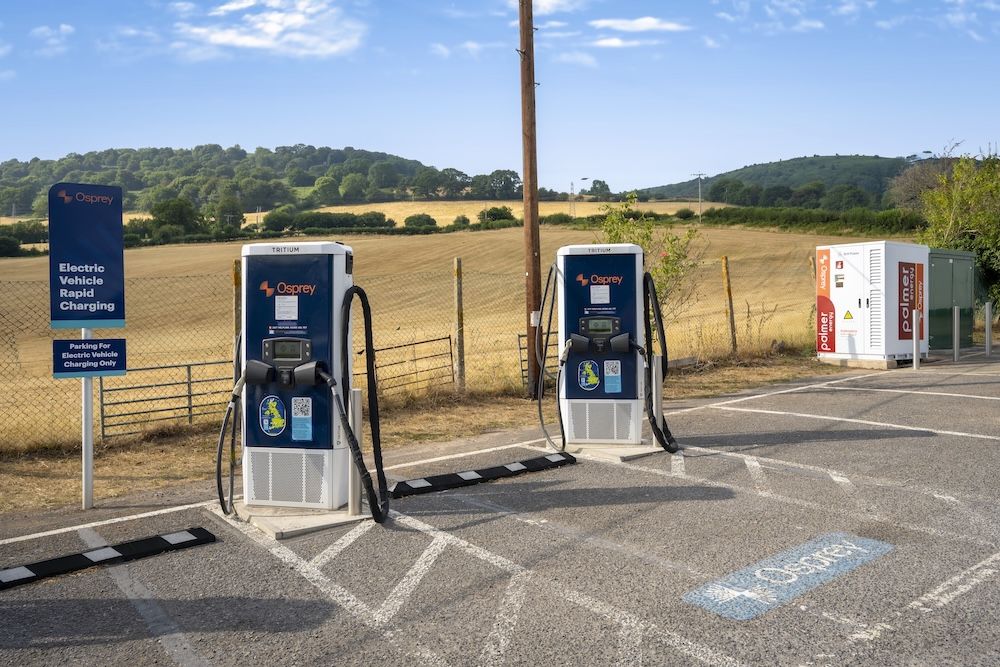
Rapid charge point operator Osprey Charging Network has installed a Battery Energy Storage System (BESS) at its Lamb & Flag charging station on the A40 in Abergavenny.
It is the first charging site on Osprey’s nationwide network to benefit from an integrated battery system.
Analysis of the dynamics of the system on a low-voltage grid connection at a busy charging site will be used to inform further BESS integration on the Osprey estate.
The company’s proprietary software platform Osprey Iris will analyse battery and site performance, including energy input, output and associated costs, to ensure future deployment of BESS is targeted to the EV charging sites where needed.
Osprey partnered with Palmer Energy Technology on the project.
BESS integration complements grid connections in delivering high-power charging, as the cost of the standing and capacity charges associated with maintaining large grid connections continues to rise, Osprey added.
At some ultra-rapid charging hubs, energy costs have risen significantly since changes to levies in 2021/22. ChargeUK reported in 2025 an average increase of 462% in fixed network charges across public chargers of all speeds.
Osprey’s Head of Development, Marcus Lewis, said:
“We know there are significant benefits to integrating battery storage with rapid EV charging, allowing us to fine tune our grid connections whilst delivering the ultra-rapid charging and market-leading Osprey experience customers expect.
“However, we want to be targeted in our deployment of BESS on the Osprey estate. This isn’t a PR stunt. Our trial sites will equip us with crucial analysis and guide the roll out to come.”
Palmer Energy Technology’s Chief Commercial Officer, Peter Freedman, said:
“We’re delighted to have worked with Osprey to install their first BESS at the Lamb & Flag in Abergavenny, and support them with valuable operating data and insight to inform the installation of further battery solutions across the UK.
“By utilising our intelligent battery management system (BMS) and energy management system (EMS) we are able to optimise the performance of the BESS in real-time, alongside maximising usable capacity and improving system efficiency for Osprey.”
Image courtesy of Osprey