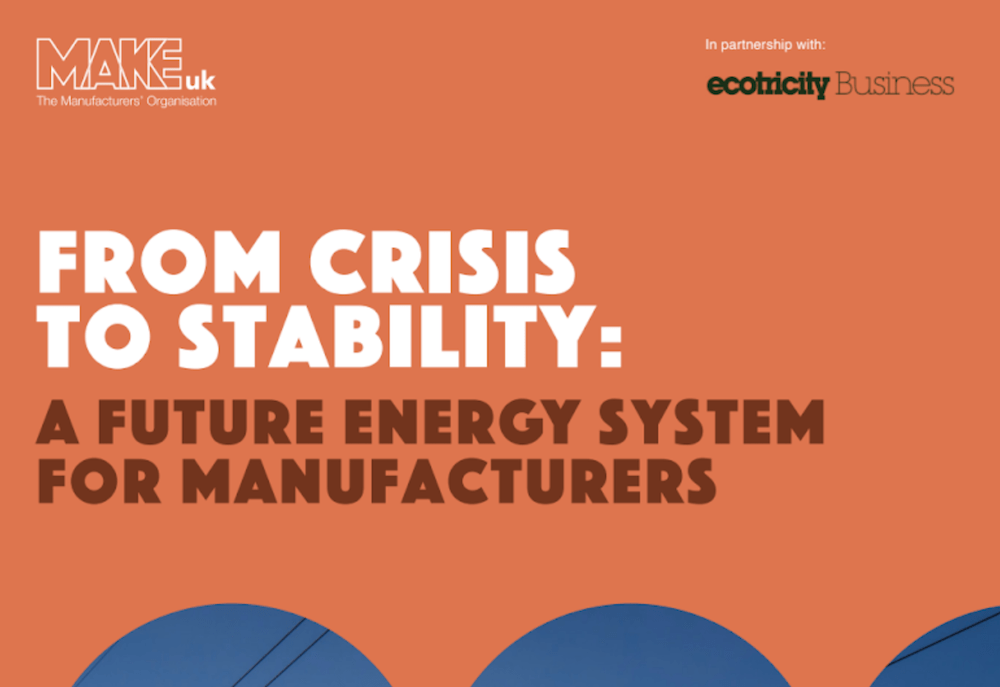
Manufacturers are warning of an estimated £85bn hit if the UK Government does not act to reduce industrial electricity prices, according to a report by Make UK in partnership with Ecotricity.
The report, From Crisis to Stability: A Future Energy System for Manufacturers, sets out how high and volatile energy prices are affecting manufacturers and the reforms needed to support growth, profitability and decarbonisation as the UK enters another period of political transition.
It finds that 90% of manufacturers said energy bills have increased at least moderately since 2022, while more than half of the companies identified energy costs as their biggest challenge over the coming years.
Some 13% say further projected energy cost rises could threatened their operative viability. Make UK estimates that a 13% decline in UK manufacturing activity could mean an annual loss of £85bn to the economy, including around £50bn across supply chains.
The report also highlighted how high energy costs are feeding through the wider economy, with seven in ten manufacturers passing higher bills on to consumers while rising costs squeeze margins and delay investment.
Make UK said the UK’s electricity system is “structurally failing manufacturers” because gas still sets the wholesale price of power too often, policy levies are loaded onto electricity bills, and slow grid connections, ageing infrastructure and inefficient post-Brexit energy trading arrangements add further cost and complexity.
Despite these pressures, manufacturers remain committed to net zero and see the transition as a route to greater resilience. Almost three quarters believed a renewable-led power system is the route to cheaper power, while 71% say net zero is important to their operations.
Make UK is calling for:
- Deliver the British Industrial Competitiveness Scheme this year and extend to all manufacturers
- Move electricity policy levies into general taxation to provide immediate relief for manufacturers
- Expand business rates relief for green investment
- Create a successor to the Industrial Energy Transformation Fund
- Accelerate structural reform of the electricity market
- Reform the grid so it prioritises existing industrial demand
Commenting, Stephen Phipson CBE, CEO of Make UK, said:
“High energy costs are one of the biggest threats to the future of manufacturing in the UK. Companies want to invest, innovate and decarbonise, but they cannot do so while electricity prices remain internationally uncompetitive.
“The incoming Government must act quickly, ensuring support reaches the whole manufacturing base while investment decisions are being made now. That means delivering the British Industrial Competitiveness Scheme this year, extending it to all manufacturers, and moving policy costs off electricity bills.
“Manufacturers are not asking for permanent subsidy. They are asking for an energy system that allows them to compete, invest and grow in the UK, at a time when wider business cost burdens have already increased significantly since 2024. Without urgent action, we risk losing industrial capacity that will be extremely difficult to rebuild.”
Dale Vince OBE, Founder of Ecotricity said:
“Ecotricity has been campaigning for years now – to end the energy market absurdity that sets the price of all electricity to be the same as that from gas. This ‘link’ prevents Britain’s lower cost green energy from bringing down energy bills. It ensures that British manufacturers remain exposed to volatile global gas markets, undermining competitiveness – for no good reason at all.
“The economic case for reform is clear. During the 2023 energy crisis, breaking this link would have saved UK businesses an estimated £30 billion. Inflation could have been 1.5 percentage points lower, Bank of England interest rates almost one percentage point lower, economic growth 0.6 percentage points higher, and the UK economy £36 billion bigger in GDP terms. The link fundamentally undermines our economy, as well as forcing overpriced energy on us.
“British companies continue to face some of the highest energy costs in Europe – our next Prime Minister must seize the opportunity to lift this burden from our whole economy and finally ‘break the link’.”
The report also points to manufacturers already taking action, including David Nieper, Schneider Electric and Numatic, which have invested in solar, electrification, energy efficiency and digital optimisation to cut emissions and energy costs.
Make UK says these examples show the ambition already present across the sector, but warns that business action cannot compensate for a national energy system that remains too expensive, volatile and slow to support industrial transformation.
The report concludes that cheaper, cleaner and more secure power is essential for protecting UK manufacturing and enabling the next phase of industrial decarbonisation.