
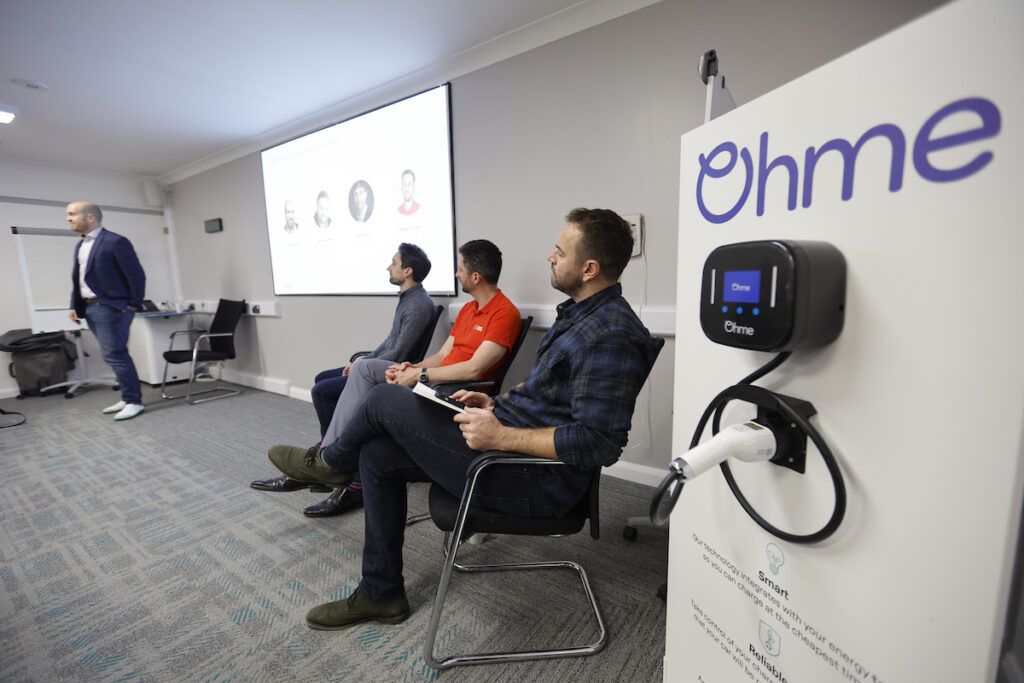
A practical breakfast workshop held at the Transport + Energy Forum with Ohme, Kerbo Charge, Motability Operations and London Councils highlighted the opportunities for cross-pavement electric vehicle (EV) charging solutions.
Exclusively for local authority officers, the packed workshop illustrated the need for solutions for a third of drivers in the UK who don’t have access to off-street parking. Cross-pavement solutions offer a safe, practical way to bridge this gap.
Local councils are critical to making the EV transition fair and equitable. By enabling residents without driveways to charge at home, authorities can ensure the benefits of lower running costs, convenience and cleaner air are shared across all communities.
Ohme trials
Speaking first, Russ Morgan from EV charging firm Ohme, said that if the sectors want “everyone to transition to EVs, we must make home charging accessible to on-street”.
Morgan highlighted how due to his energy contract and set-up, he had only spent £106.32 on charging for his electric vehicle across the year, showcasing how the transition can lead to significant savings during the cost of living crisis.
He spoke about the “positive momentum” in the industry, including the removal of planning permission for on-street charging solutions.
Speaking specifically about the cable trials, he said there was a 96% rating in durability and quality, 96% rating on ease of use, that chargers for cross-pavement were used around three times a week, 67% of the customer’s trialling the products used the locking device, and it was 100% rated for pedestrian safety with a seamless, flat, flush surface to the kerbside.
Morgan also explained how such solutions added value to a property, and providing a future-proofed design and a permanent solution was an “asset” to homeowners.
He concluded that “consistency, affordability, accessibility and confidence” would all be critical elements in the transition to electric vehicles, when considering a cross-pavement solution.
Motability Operations
Jonathan Jenkins from Motability Operations added that there were around 200,000 customers across the UK who benefited from Motability who could access cross-pavement solutions in their locality.
Specifically, looking at the data in a piecemeal way, across local authority areas, for each one across the country there would be “several hundred” Motability customers who could benefit from such products and solutions.
Jenkins highlighted the need for accessibility in the solutions, and how important it would be for Motability customers in order to be able to successfully access cross-pavement charging solutions. This included the weight of the cable, need to crouch and bend over to access the channel, and ability to lay the cable to the kerbside. Resolving such issues was vital if Motability customers were going to be able to utilise cross-pavement solutions.
He explained how the company had bought some customers into its offices to trial some of the possible solutions which met accessibility standards, and highlighted that there were some leading brands which did not currently fulfil the needs of its customer base – although he also said there were several products that did work and could be accessed.
London Councils
Richard Evans from London Councils said the organisation’s role was to co-ordinate borough-wide efforts across the capital and to manage pan-London LEVI programmes.
He said that it provides strategy and technical support to boroughs, and cross-pavement charging is “increasingly relevant” as 60% of households in the capital lack off-street parking.
As a result, London Councils developed guidance, case studies, policy briefings, and advocacy, on behalf of councils on the issue. It also engaged with suppliers and stakeholders to explore technical, legal, safety and accessibility considerations.
In terms of considerations for councils, Evans said there was a series of opportunities and challenges
Opportunities included:
- Equity and access
- Lower charging costs
- Addressing trailing cable risks
- Scalability and integration
- Encouraging EV uptake
- Meeting net zero and climate goals
Challenges
- Accessibility and inclusivity concerns
- Electrical safety, earthing, and emergency isolation risks
- Planning and licensing requirements
- Resource and cost implications
- Impact on streetscape
- Liability and insurance uncertainties
Kerbo Charge
Michael Goulden, Co-founder of Kerbo Charge, started by positing the question of “How do we make lost cost charging inclusive for all?”
He explained how there were two options, which are either to trail a cable or to use public charging for those without off-street parking. On the first point, he said the issue was the potential for personal injury, and on the second point the issue was inconvenience and cost, with public charging costing around £34.50 at average current prices compared to £4.62 at home.
Goulden added that around 80% of electric vehicles at present were sold to customers who had driveways, illustrating the start divide.
Speaking about his product, which won the support of Deborah Meaden on BBC show “Dragons’ Den”, it has a self-closing lid which only opens at a small section at a time. A memory-polymer lid snaps shut to eliminate a trip hazard, and it has been tested by the BSI. It flexes with bendy and uneven pavements as well, with installs taking roughly one hour.
On trials of the product across 13 councils, Goulden added that there was now a “wealth of experience” on cross-pavement solutions, and how to apply them.
Specifically for accessibility, the Kerbo Glide is a plough-shaped cable insertion tool, which was developed based on the requests of Motability, and allowed for greater accessibility for on-street solutions.
Goulden was also keen to add the importance of making the management of on-street solutions being as seamless as possible, and creating an end-to-end order management system allowed for a single version of cross-pavement channel installs across a locality.
He highlighted how it was important to simplify data and management in order to make installs as easy as possible for local authorities to take forward plans.