The EU has a €24 billion economic stake in the success of UK automotive manufacturing, according to a new study by the Society of Motor Manufacturers and Traders (SMMT).
The “deep integration” of the EU-UK auto manufacturing industry come as EU talks on its Industrial Accelerator Act (IAA) intensify, and highlights the importance of the UK to Europe’s vehicle markets and supply chain, the SMMT added.
EU manufacturers sell more automotive components to the UK than any other global market, and the UK is the EU’s largest export market for passenger cars, with an overall trading relationship worth €80 billion annually.
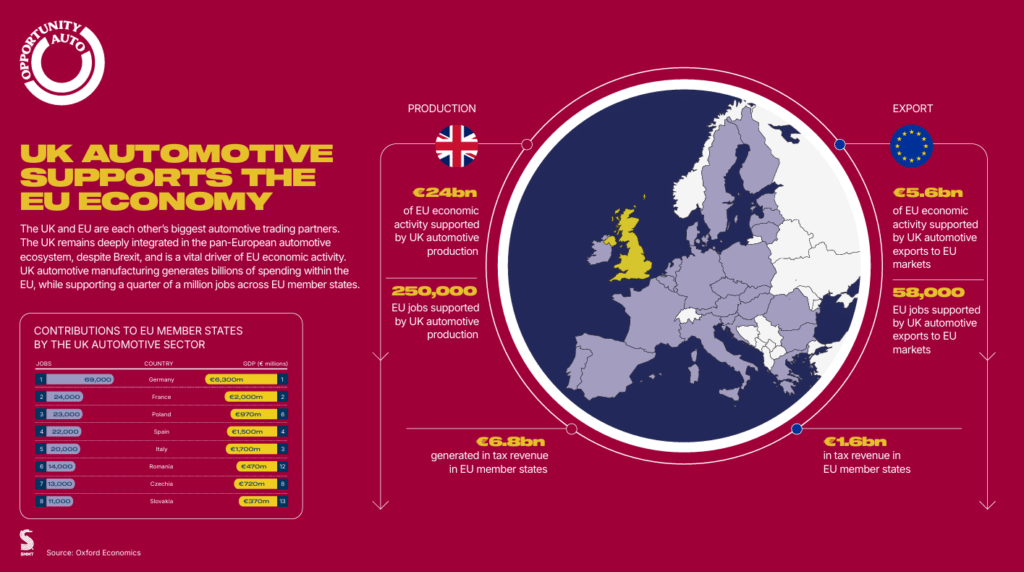
The analysis, carried out by Oxford Economics, estimates that UK automotive production supports €24 billion of economic activity across the EU, spanning every sector from utilities to financial services and real estate.
The UK auto sector also sustains 250,000 EU jobs through supply chain activity and wage-funded consumer spending, while UK automotive exports to the EU alone generate €5.6 billion of spending across the bloc, supporting 58,000 jobs and €1.6bn in tax revenues.
These jobs and economic value would be at risk from the ‘Made in Europe’ provisions, which, as drafted, would see future UK-built vehicles denied access to incentives available to EU-built products, including support for greener corporate fleets and CO2 super credits, and be excluded from EU Member State procurement, despite the UK’s role in Europe’s automotive supply chain, the SMMT said.
Such an outcome would put UK production at “a competitive disadvantage in its largest market, reducing demand for UK-built vehicles and, in turn, reducing UK sourcing of EU components, goods and services”, it added.
The exposure would be felt across Europe’s major automotive economies, with the biggest GDP impacts in Germany, France, Italy and Spain – at around €6.3 billion, €2 billion, €1.7 billion and €1.5 billion respectively.
In addition, UK output supporting 69,000 jobs in Germany, 24,000 in France, 22,000 in Spain and 20,000 in Italy. Across central Europe, the numbers are even larger, with UK automotive production supporting 23,000 jobs in Poland, 14,000 in Romania, 13,000 in Czechia and 11,000 in Slovakia.
Mike Hawes, SMMT Chief Executive, said:
“The EU and UK automotive sectors have traded, invested and grown together over many years. Despite Brexit, supply chains remain deeply integrated and the cross-Channel trading relationship is worth €80 billion a year, supporting jobs, growth and investment.
“The EU is rightly focused on strengthening its industrial base, but the UK remains fundamental to Europe’s automotive ecosystem and is therefore essential to that ambition. Excluding the UK from ‘Made in Europe’ would be an own goal, weakening competitiveness, reducing scale and limiting consumer choice. We need a better outcome – one that recognises UK Automotive as a trusted partner in the Industrial Accelerator Act and strengthens, rather than fragments, Europe’s automotive industry.”
Graphic courtesy of the SMMT