More than £7 billion has been committed to Britain’s emerging electric vehicle battery supply chain, according to a report published by New AutoMotive.
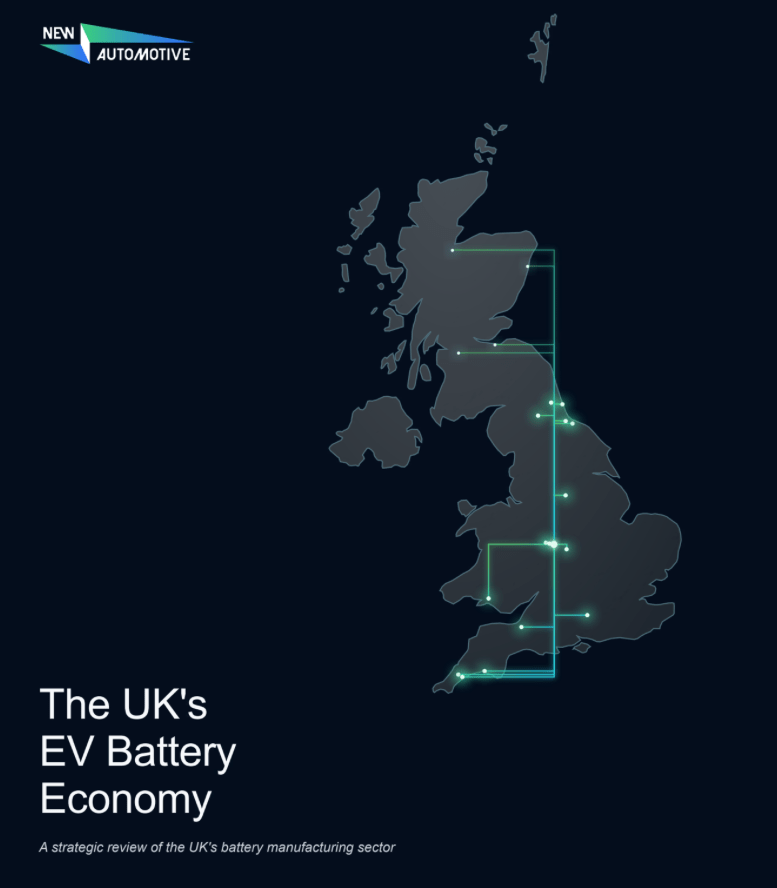
The report, titled The UK’s EV Battery Economy: A strategic review of the UK’s battery manufacturing sector, authored by Ciara Cook and Ben Nelmes, provides an audit of the UK’s battery economy.
It tracks more than 14 major commercial projects spanning lithium extraction and chemical refining, large-scale cell gigafactories, cutting-edge materials science, and next-generation hydrometallurgical battery recycling.
Together, the UK’s battery supply chain already generates £4.2 billion in annual turnover and supports over 10,000 direct, high-value jobs across regional industrial hubs.
It highlights how battery investments such as:
- Gigafactory Manufacturing: Envision AESC’s expanding 15.8 GWh facility in Sunderland and Agratas’s £4 billion, 40 GWh facility currently under construction in Somerset to supply Jaguar Land Rover.
- Domestic Mineral Extraction: Lithium extraction projects from Cornish Lithium in the South West and geothermal brines in County Durham (Northern Lithium and Weardale Lithium), establishing sovereign domestic supplies.
- Chemical Refining Hubs: Commercial refining facilities planned by Tees Valley Lithium and Green Lithium (Teesport) to process battery-grade lithium hydroxide on British soil.
- Midlands Innovation: The shovel-ready 60 GWh GreenPower Park at Coventry Airport
In addition to primary manufacturing, the report reveals a structural competitive advantage in battery recycling and circular economy minerals.
Because right-hand-drive vehicles registered in the UK are rarely exported second-hand across borders, retired EV batteries overwhelmingly remain within the UK. This creates a “captive domestic feedstock” of high-grade lithium, nickel, and cobalt.
The report argues that now is the time to build on Britain’s momentum, warning that policy hesitation or watering down the Zero Emission Vehicle (ZEV) Mandate risks undermining investor confidence.
By 2035, the UK will require approximately 115 GWh of battery cells each year for domestic automotive production and energy storage. While confirmed capacity covers around 60 GWh, the report stresses that the most effective way to attract the additional 2 to 3 gigafactories needed to close this gap is by providing domestic demand certainty.
To safeguard the investment pipeline, New AutoMotive outlined five priority policy recommendations:
- Hold Firm on the ZEV Mandate
- Deliver Competitive Industrial Electricity Prices
- Deploy Minister-Led Deal-Making for Coventry
- Retain Strategic Feedstock in the UK
- Modernise Waste Laws & Introduce Battery Passports
Ben Nelmes, CEO at New AutoMotive, said:
“The UK has built real momentum in the battery supply chain, securing over £7 billion in investment for projects that will drive our industrial future. Delaying or diluting the EV transition now would directly undermine investor confidence, putting those billions of pounds, thousands of skilled jobs, and our broader competitive edge at risk.
“Businesses need a stable, long-term policy framework to build these factories and secure Britain’s role as a leader in the global clean energy transition.”
Image of report courtesy of New AutoMotive