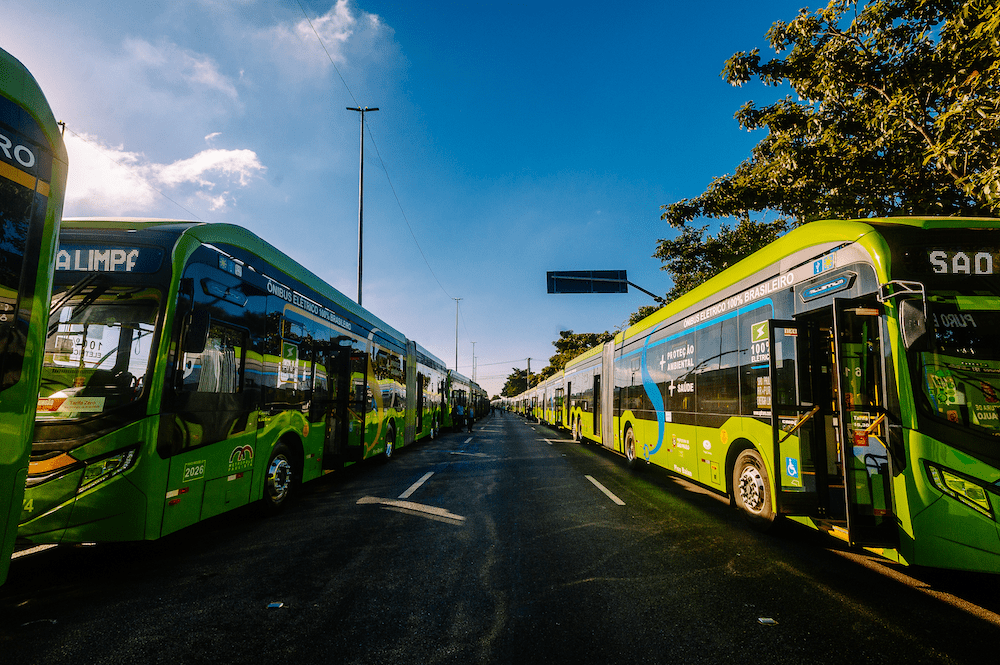
Cities across Latin America have reached the historic milestone of 10,000 electric buses in operation, according to data from E-Bus Radar.
The data was announced by C40 Cities and the International Council on Clean Transportation (ICCT)during Lat.Bus 2026, the region’s largest transport and mobility event.
It represents a “turning point in the decarbonisation of public transport”, the company said, across the continent and “reinforces electric mobility as a concrete response to the climate crisis, improving air quality and the health of urban populations”.
It comes after 80 cities in 13 Latin American countries have accelerated the electrification of their fleets in recent years.
Santiago, São Paulo and Bogotá are leading electric mobility with more than 7,000 electric buses in operation across the three cities, and São Paulo is now home to the region’s second-largest fleet. The operation of these buses is estimated to avoid more than 10 million tonnes of CO2 emissions every year.
In Brazil, programmes such as the ZEBRA Alliance and the Mutirão Brazil Program, a joint initiative of C40 Cities and the Global Covenant of Mayors for Climate & Energy (GCoM), have seen zero-emission technologies used to modernise public transport, improve air quality and accelerate the decarbonisation of cities.
Since 2019, C40 Cities and the ICCT, through the ZEBRA Partnership and alongside other partners, have supported São Paulo and other cities, such as Bogotá, Mexico City, Salvador and Curitiba, throughout the development and structuring of this financing model, helping to connect municipal stakeholders, financing institutions and suppliers.
The São Paulo case offers a replicable roadmap for other cities: combining regulatory requirements for fleet renewal with clean vehicles and a financing package that shields municipalities from the initial burden of investment.
The combination of stronger regulation and strategic technical assistance from city networks is what C40 and GCoM are seeking to scale through programmes such as Brazil Mutirão, supporting local governments in financial modelling, resource mobilisation and the integration of monitoring tools, it said.
Ilan Cuperstein, C40 Cities Regional Director for Latin America, said:
“Reaching 10,000 electric buses in operation shows that the transition to zero-emission transport is no longer a promise but a reality in Latin American cities. What was once the exception is now an expanding public policy, delivering direct benefits for the climate, health, public transport quality and local economies.
“The message to other cities is clear: financing does not have to be a barrier. Tested pathways exist, and the network is ready to support those willing to take them.”
Ricardo Nunes, Mayor of São Paulo, said:
”We are accelerating the energy transition of the country’s largest city and consolidating a public policy that is already a national and international benchmark.
“Through a single delivery of 500 new electric buses in June, the city achieved the environmental equivalent of planting 3.2 million trees per year. This avoids the emission of 45,000 metric tons of CO₂ while cutting annual diesel consumption by approximately 20 million litres.”
Image courtesy of Brazil Mutirão