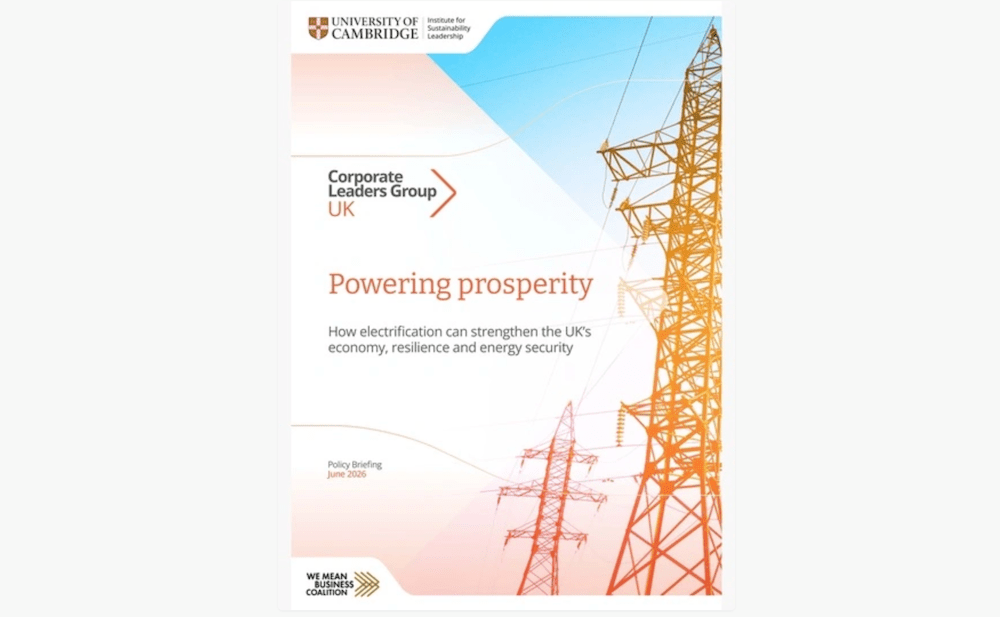
Accelerating electrification across the UK economy could deliver stronger economic growth, increase energy security and create around 250,000 jobs, according to a new report from the University of Cambridge Institute for Sustainability Leadership (CISL) and the Corporate Leaders Group UK (CLG UK).
The report, Powering prosperity: How electrification can strengthen the UK’s economy, resilience and energy security, finds that moving away from fossil fuels towards electricity offers a clear strategic advantage in an increasingly uncertain global environment.
The analysis shows that an electrification-led pathway delivers the strongest outcomes for the UK economy. Compared to alternatives, it drives higher GDP growth, boosts productivity, and supports sustained investment in domestic infrastructure and clean technologies.
By 2050, the UK GDP would be over one percentage point larger in the electrification-led scenario than if we continue current policies.
The electrification-led pathway also has significant employment benefits, creating around 250,000 more jobs than current policies by 2050 in sectors including construction, manufacturing and services.
The report highlights electrification as a key route to improving the UK’s energy security. By reducing dependence on imported oil and gas, it lowers exposure to volatile global markets and price shocks.
Under electrification, fossil fuel imports could fall by over 45% compared to current trajectories. Despite higher than present per-unit electricity prices, energy expenditure would decline by 50% and be more predictable, making planning easier for businesses and households.
A fossil-led development pathway, on the other hand, would increase the need for energy imports. Energy expenditure would likewise increase in a fossil-led future, rising over 40% higher than if the current policies were extended to 2050.
As geopolitical uncertainty and energy market volatility continue, the report concludes that faster, coordinated action on electrification is essential.
Electrification is not simply a climate pathway, but a strategic economic choice that can deliver stronger growth, greater resilience, and a more secure energy system for the UK, it added.
Eliot Whittington, Executive Director, CISL said:
“The UK has a choice of energy futures, and this analysis sets out the clear numbers. A clean power-based energy system is cheaper overall, better for the economy, better for jobs, better for energy security, and better for the climate. Of course, there are real discussions to be had about how best to implement the change, but clean electrification is good for Britain, and we should work out how we best move to a clean power future.”
Caspar Herzberg, CEO of AVEVA, said:
“Resilience is fast becoming a strategic imperative for national economies. Electrification sits at the nexus of economic growth and energy security and, as the CLG UK report shows, it has the potential to drive employment and productivity gains while reducing exposure to energy supply volatility and price shocks. Paired with digitalised grids and advanced analytics, electrification enables a more secure, efficient and future-ready energy system that strengthens global competitiveness.”
Roy Bedlow, Founder and chief executive of Low Carbon, said:
“As the CLG UK’s report makes clear, reducing reliance on fossil fuels minimises our exposure to volatile global energy markets and soaring energy costs. However, realising these benefits depends on renewable projects being able to connect to the grid and the government moving quickly on issues such as reenabling battery co-location which is essential for large renewable projects to balance the system, reduce negative pricing and ensure growing power use does not translate into higher emissions.”
Image of report courtesy of CISL/CLG