Adam Dunwoodie, Technical Manager at Easee, explains how if an electric vehicle (EV) can be charged at extreme temperatures in the Arctic circle, it can be done anywhere.
There is a moment, standing on a frozen lake in Canada’s Northwest Territories at minus 45°C, when technology stops being theoretical. The wind makes conversations about energy transition very concrete, very fast. Your fingers stop working. Your breath freezes before it leaves your face. And yet, in front of you, a solar-powered EV charger is quietly doing exactly what it was designed to do.
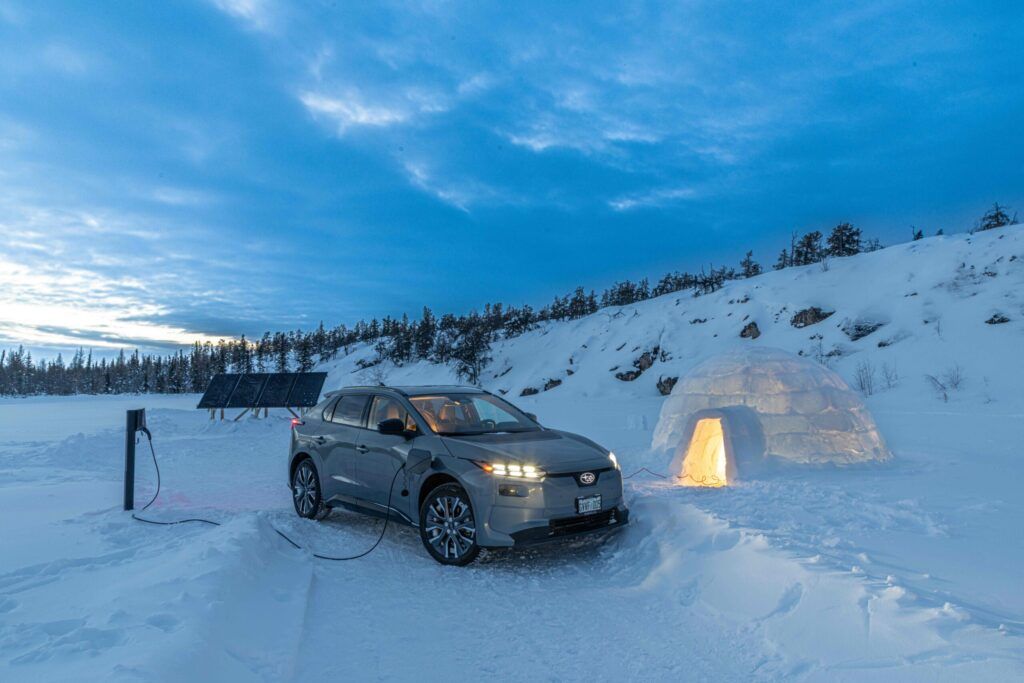
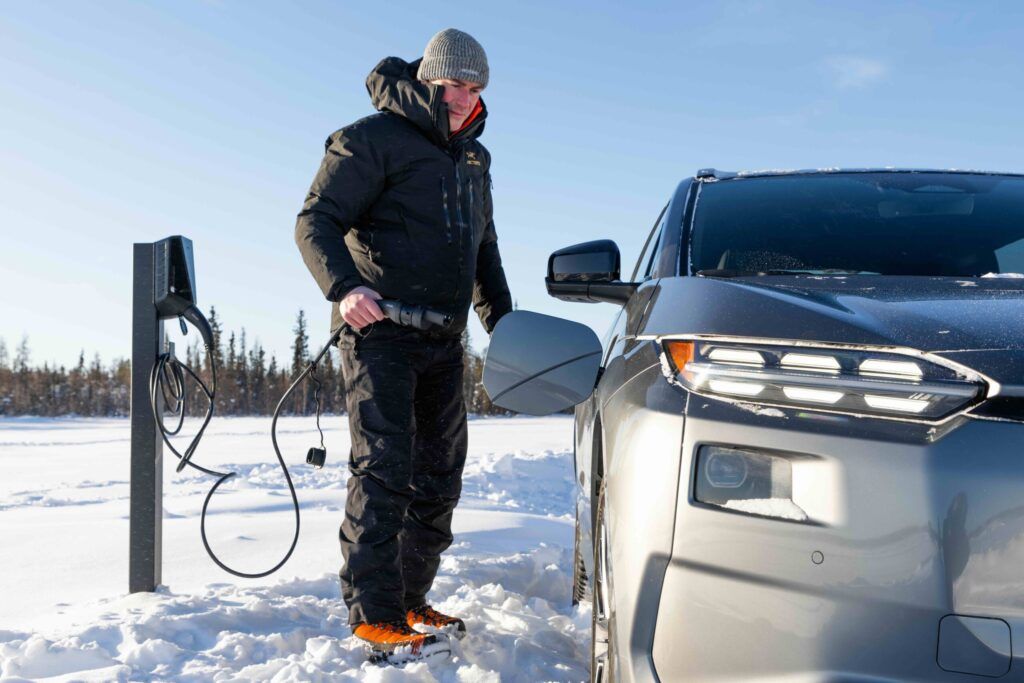
That moment, the app confirming a live charge, the dashboard showing power flowing, engineers exchanging frozen high fives, was why Easee partnered with the Government of the Northwest Territories and Subaru Canada to run one of the most demanding real-world EV charging pilots we have undertaken. Not in a lab, but on an subarctic lake, 500 kilometres south of the Arctic Circle, in one of the harshest inhabited environments on Earth.
The clean energy industry has a habit of proving itself in ideal (warm) conditions. But the communities that stand to benefit most from energy independence, remote indigenous settlements, military outposts, off-grid towns, live nowhere near ideal conditions. In Canada’s Northwest Territories alone, hundreds of communities depend entirely on expensive, carbon-intensive fuel flown in by small aircraft. When supply chains break down, so does daily life. When they ask whether renewable charging infrastructure can genuinely serve these places, we owe them an honest answer.
That is why we chose Yellowknife. With unpolluted skies, intense UV radiation, and over 250 sunny days per year, the subarctic is not as inhospitable to solar as its reputation suggests. What it demands, however, is hardware that continues to function in extreme cold. Assumptions are not enough. Testing must happen where the conditions are real.
What we found

Our team mounted four 455W solar panels on a temporary frame, connected them to an EcoFlow Delta 3 Pro battery power station, and plugged in a Subaru Solterra to an Easee charger bolted directly to the ice. At midday, with the sun low on the horizon, the system delivered 2.5kW at minus 45°C. It was not fast. But it was functional. Off-grid. In extreme cold.
The implications scale quickly. With 12 to 16 panels instead of four, output would match a standard domestic 7kW charger in Europe. For communities currently paying extraordinary sums to import diesel and petrol, that is a meaningful threshold. It is the difference between energy dependence and genuine autonomy.
This pilot was observed by members of the local Inuit community, including elder Beatrice Bernhardt, who was born in an igloo in the 1950s. Her perspective was direct: “My view on technology is that it’s good. We can use the technologies that we need to live up here, so we will embrace that.”
Her point is practical rather than ideological. The Inuit’s last truly carbon-neutral transport was the dog team, six decades ago. Today, with no roads leading north out of Yellowknife, light electric vehicles and flexible solar arrays are not a replacement for dog sleds, but they could meaningfully extend range, reduce fuel costs, and restore a degree of the self-sufficiency that defined Inuit life for millennia. Solar-charged electric snowmobiles are a realistic near-term application. The technology is ready; what is needed now is deployment at scale.
Beyond indigenous communities, the implications extend further. As the Arctic gains geopolitical importance, resilient and decentralised power generation becomes increasingly significant. Infrastructure that operates independently of fragile supply chains strengthens local resilience as well as climate goals.
Climate change is not waiting
The urgency is not abstract. Climate change is happening several times faster in the Arctic than in temperate zones. In the summer of 2023, wildfires forced the full evacuation of Yellowknife. Drought is affecting water supply. Power cuts lasting hours are not unusual. Ryan Connon, the Northwest Territories’ senior scientist, is frank about what is coming: extreme events will continue, and the communities living there need solutions that hold up under pressure.
The cost of living in the north is already at a tipping point. Energy independence is not aspirational, it is an economic and social necessity. The communities we spoke to are not waiting for perfect conditions. They are asking whether the technology works well enough, right now, to make a meaningful difference. Based on what we proved on that frozen lake, the answer is yes.
If it works here, it works anywhere
Andrew Williams, who runs Yellowknife’s electric car share programme with 35 members and a small fleet of EVs, put the significance of our test simply: “If it can be done here, it can be done anywhere.” Local solar expert Ben Balmer, who oversaw the panel performance testing, was equally direct: “This test is just the beginning. We have to adapt up here to survive and thrive. And what works up here will benefit the rest of the world.”
At Easee, reliability in real-world conditions is fundamental to how we design hardware and infrastructure. Across our installed base, our chargers deliver 99.5% uptime. Laboratory validation matters. But performance in the environments where people actually live matters more.
The Arctic test is complete. The Solterra drove off across the frozen lake on solar power. The work, as Ben said, is just beginning.