Weak demand signals and delays to policy delivery are holding the UK hydrogen industry back, according to a new report from the Hydrogen Energy Association (HEA).
The State of the Hydrogen Nation by the HEA, includes responses from 142 organisations spanning production, infrastructure, manufacturing, transport, end-use and finance. It finds that while confidence has softened year-on-year, this is not due to doubts about hydrogen’s long-term role, but growing frustration at the pace and predictability of policy delivery.
The UK’s regulatory framework for hydrogen is perceived as strong and investable but policy and funding delays are affecting confidence, it found.
More than 84% of organisations expect their UK hydrogen investment to increase or remain stable over the next 12 months, demonstrating that appetite to invest remains strong, it found.
However, nearly half of respondents believe government commitment to hydrogen has weakened compared to a year ago, citing policy delays, stop-start funding rounds and unclear timelines as key concerns. The report identifies demand creation as the single biggest constraint on the growth of the UK hydrogen market.
It also found:
- 81% of organisations seeking offtakers say securing hydrogen offtake agreements is difficult
- 60% of potential end-users say integrating hydrogen into operations is challenging
- Key barriers include lack of infrastructure, high or uncertain costs, length of Hydrogen Allocation Round’s contracts, and insufficient long-term demand-side policy support.
Without action to unlock demand, the report warns that the UK risks slowing deployment even where production support mechanisms are in place.
Under existing conditions, survey respondents expect the sector to support around 3,800 UK hydrogen jobs by 2030. Under an improved policy environment – with faster decision-making, clearer demand signals and better-aligned delivery – that figure rises to around 17,000 jobs over the same period.
Internationally, the UK remains one of the world’s most attractive destinations for hydrogen investment, ranking second only to Germany in respondents’ perceptions, it added.
Dr Emma Guthrie, Chief Executive of the Hydrogen Energy Association, said:
“This report shows a sector that is committed, capable and ready to deliver – but increasingly constrained by uncertainty over demand, policy design and delivery timelines.
“The question is no longer whether hydrogen has a role in the UK’s energy system, but how quickly we move from ambition to deployment. With clearer signals and faster delivery, the UK can unlock thousands of skilled jobs, attract investment and secure a leading global position.
“In short, collaboration and coordinated action at pace are essential to creating the right conditions to enable investment, create high-skilled jobs and to support the UK’s net zero and energy security objectives.
“The Hydrogen Energy Association, alongside its members and partners, stand ready to work with Ministers, officials, Parliamentarians and the wider UK hydrogen industry to make that happen.”
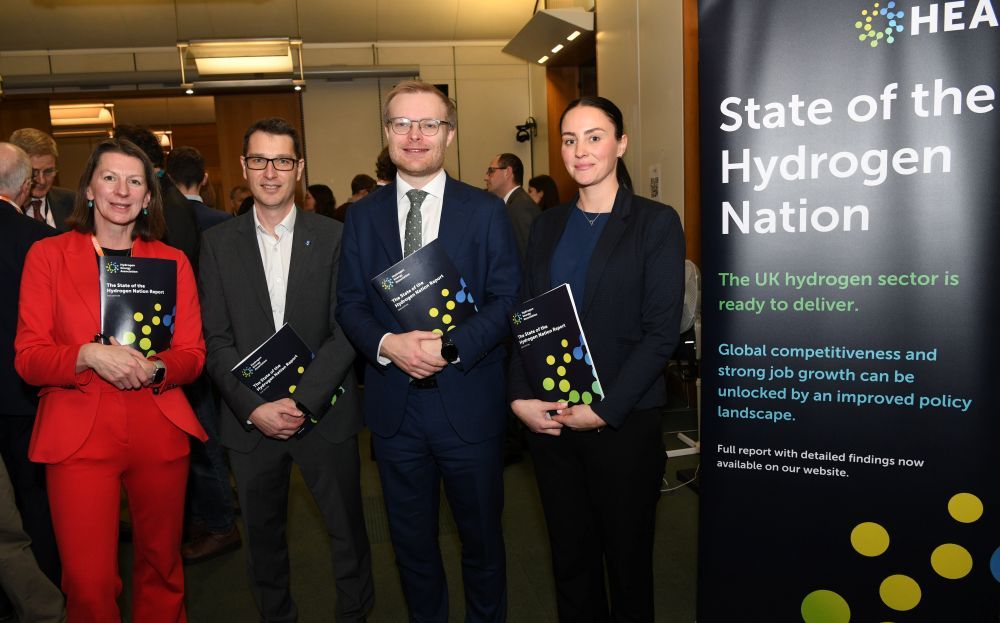
Michael Shanks MP, Minister for Energy, was at the parliamentary launch, which was supported by Luxfer Gas Cylinders and Chesterfield Special Cylinders – contributors to the UK hydrogen supply chain and members of the HEA.
Keith Croysdale, Business Development Manager at Luxfer Gas Cylinders, added:
“The UK has the skills, manufacturing base and innovation to lead in hydrogen. What’s needed now is coordinated delivery to turn that potential into scale.”
Rachel Grundy, Commercial Director at Chesterfield Special Cylinders, said:
“This report reflects what we are seeing across the supply chain – strong technical capability and willingness to invest, but a real need for clearer market signals to justify long-term commitments.”
Image from HEA shows HEA CEO Dr Emma Guthrie, Mark Lawday of Luxfer, Minister Shanks. Rachel Grundy of Chesterfield Special Cylinders