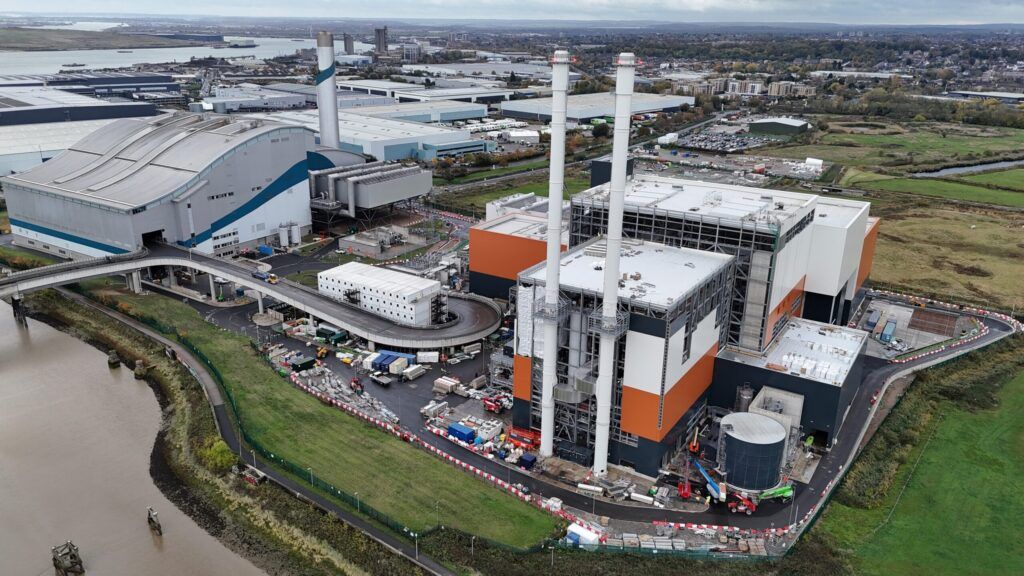
UK Power Networks and Cory Group have partnered to connect one of the largest energy from waste (EfW) facilities in the UK to the electricity network.
The project will connect the new ‘Riverside 2’ EfW to the electricity network on the banks of the River Thames in Belvedere, London.
Riverside 2 is projected to turn 650,000 tonnes of non-recyclable waste into energy that could produce enough power for 176,000 homes, the company said.
Processing waste at Riverside 2 will prevent non-recyclable materials being sent to landfill or overseas, improving waste infrastructure in the capital, the company said. Riverside 1, located on the same site, currently diverts around 800,000 tonnes of waste from landfill each year.
In total 10.6 kilometres of cross-linked polyethylene cable has been used, with engineering innovation at the heart of the project using a cable route that maneuvered around three different rivers and associated bridges, using directional drilling when needed, minimising environmental impact and disruption.
On the River Darent, steel pipeway was installed to carry the cable across the river, via the existing A206 bridge, and on the River Cray, cable was laid in a cable trough fixed to the underside of the existing bridge over the river, removing the need to drill beneath the waterway. The new circuit will provide an extra 82.5 Mega Volt Ampere (MVA) to the network to help cater for future electricity needs.
The facility was successfully connected to the electricity grid through collaborative works by Cory’s construction partner JSM and UK Power Networks.
JSM installed the substation and the 132,000-volt route to Littlebrook Substation, while UK Power Networks undertook significant upgrades at Littlebrook, including refurbishing a 132,000-volt circuit breaker, installing metering transformers, upgrading protection systems, and laying high-voltage cables within the substation boundary.
UK Power Networks programme manager, Jason Taylor, said:
“The Riverside 2 project overcame complex engineering challenges along the way. The route tackled three different river crossings with tailored solutions: directional drilling at Norman Road, fixing of the cable trough carrying the cables to the underside of the existing bridge at the River Cray, and the construction of a dedicated cable bridge over the River Darent.
“These approaches minimised disruption to the environment and local infrastructure, while ensuring the robust installation of new equipment.”
Peter Kent, managing director of Riverside 2 at Cory Group, said:
“We are proud to deliver an essential public service and want to ensure there is no waste from waste – this includes recovering the energy contained in the waste we process and returning it back to local communities as baseload, partially renewable electricity.
“Riverside 2 will provide vital waste processing capacity for London and the South East, as well as generating electricity for the grid, and working together with our partners including UK Power Networks and JSM is a key part of delivering value for our communities.”
Stephen Bradley, new business director at JSM, said:
“JSM are delighted to have been given the opportunity to design and deliver the 132,000-volt substation and 10.6 kilometre 132,000-volt cable route for this nationally significant project, all to UK Power Networks specifications. The cable route was planned with a high degree of cooperation with the London Borough of Bexley and Kent County Council to ensure the minimum amount of disruption to one of the main strategic arteries from Kent into South East London. This included designing multiple special engineering difficulties such as rail and river crossings.”
Image courtesy of UK Power Networks