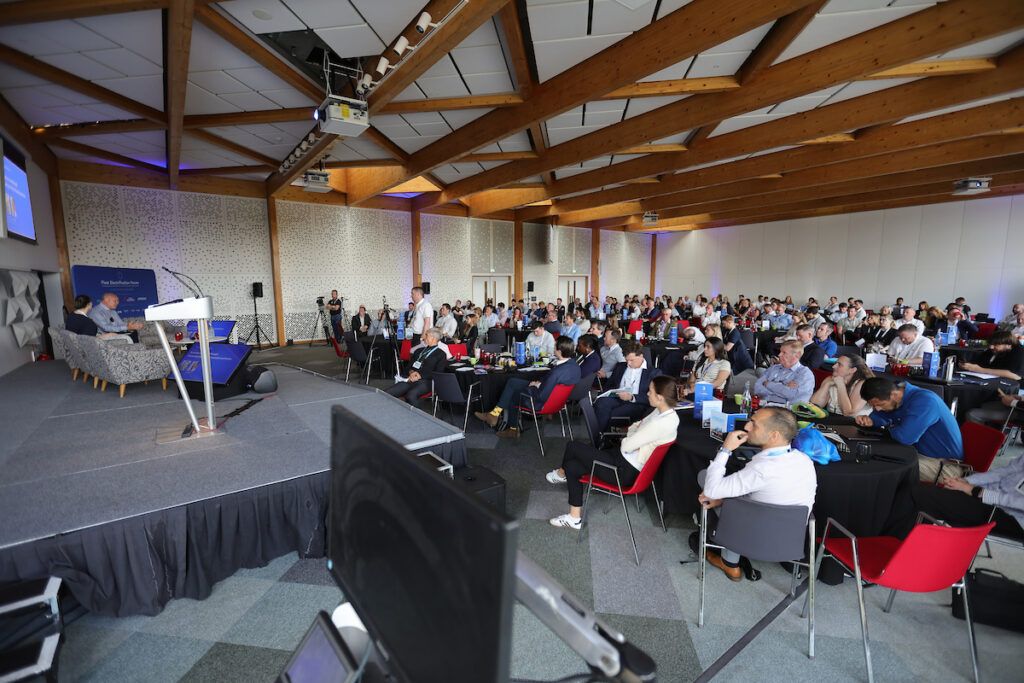
Transport + Energy’s two forums, the Transport + Energy Forum and the Fleet Electrification Forum, have highlighted the various ways that the two sectors have collaborated on decarbonisation and the net zero agenda.
Transport + Energy Forum
This year’s Forum had a theme of “commitment to certainty” with many delegates calling on the UK Government to provide a concrete framework for businesses and local authorities to build decarbonisation strategies.
It opened with founder of T+E Alec Peachey highlighting the challenges facing the sectors, and the need for certainty across the industry in order for growth and acceleration to occur.
Just transition
Chair of the All-Party Parliamentary Group for Electric Vehicles (EV) Perran Moon then told the Forum that a just transition was needed in the roll-out of EV charging infrastructure.
In a recorded message, Moon explained in terms of the deployment of EV charging infrastructure to-date, he said it had been ‘relatively’ successful, but with the benefit of hindsight “there shouldn’t have been so much involvement of local authorities”.
Moon, who before becoming a politician had previously been the chief marketing officer and interim CEO of charge point operator (CPO) Believ, added that the way that Local Electric Vehicle Infrastructure (LEVI) funding was not applied “as efficient as could have been”.
“Right side of history”
“Godfather of EVs” Andy Palmer, who launched the Nissan Leaf as well as senior roles at Aston Martin and PodPoint, then said that “we are not going to mandate EVs on people, you have to have a push and a pull”, and also highlighted the role of politicians in providing certainty in the transition.
He told EVA England chief Vicky Edmonds – who had earlier quoted Taylor Swift and the importance of “being on the right side of history” on EVs – that the cost of an EV needed to be on parity with ICE vehicles, and we were “close to achieving that”, especially if you look at Chinese vehicle manufacturers.
In addition, Palmer said that we needed to “break the monopoly” on how energy was generated and ensure there was decentralisation and democratisation in energy production. He also highlighted one case where he tried to get a battery placed at a site, and was told by the DNO that the grid connection could be done in 2037.
“Wrong messages”
President of The AA, Edmund King OBE, Edmund King, AA president, argued that Transport for London (TfL) removing the full exemption for electric vans and cars from the Congestion Charge in London and speculation (and now confirmation) about the Chancellor announcing an EV ‘pay as you drive’ scheme at the Budget are sending out the wrong messages at the wrong time for potential EV drivers.
Most drivers accept that that EVs can still cause congestion and that users should fairly pay their way, but the timing of these announcements has the potential of deterring many who are still hesitant about going electric.
King said: “There is a certain irony that on the one hand Government is offering electric car incentives of up to £3,750 to encourage more drivers to buy small EVs, whilst on the other hand are threatening to tax them per mile in three years’ time. The timing is just not right and the government does not need to outline future EV taxation plans now.”
Accessibility
Jonathan Jenkins from Motability Operations highlighted the vital role of local authorities in the transition to electric vehicles (EV).
Speaking during the afternoon session of the Transport + Energy Forum, Jenkins said that local authorities must plan for accessibility from the start – and also stressed the critical part played by collaboration in the transition to EVs.
Jenkins said “collaboration is absolutely critical” and also that “success in the transition isn’t a car nerd or an energy geek. It is about how electric vehicles are easier for those on Motability than an ICE vehicle.”
Consumer confusion
The third panel was chaired by founder of Bold Voodoo, Ben Kilbey, and also featured Vicky Read, Chief Executive of ChargeUK, Mark Camilleri, who is the Director of Electrification at JLR, CEO of EVUK Tanya Sinclair, and Delvin Lane, the CEO of InstaVolt.
The panel highlighted a number of core messages. This included consumer confusion being a real issue, with some even coming from within the industry itself. Misinformation, mixed messages and legacy technologies marketed as “electric” continue to blur the picture for drivers.
They also said that facts alone won’t win hearts: drivers aren’t just processing data but emotion, fear of change, mistrust, and uncertainty. Getting people into vehicles and having honest conversations matters more than spec sheets, they said.
In addition, the panel said that we must tell our story better: Huge innovation is happening behind the scenes: smarter infrastructure, cost reductions, new charging solutions, better vehicles. But the public rarely hears it.
Collaboration also shouldn’t be seen as a fad, and was important to how we moved forward: OEMs, charge point operators, local authorities, energy providers, policymakers shouldn’t work in isolation. Clear, consistent, truthful communication must be our shared priority, they said.
Finally, they ended on the positive note that despite the negativity, progress was real. Infrastructure is scaling, new EVs are better than ever and consumer appetite is growing.
New tool
A new guide to help local authorities speed up their EV charging rollout was also launched at the Forum by UK100 in partnership with UK Power Networks’ DSO and Cenex.
The guide, called Powering Local EV Infrastructure: A Guide for Councils, shows councils using innovative planning tools achieve 100% first-time success in government funding applications – compared with just 37% on average.
One of the findings highlighted in the guide is the transformative impact of evidence-based digital planning.
Councils using ChargePoint Navigator – a free digital tool developed by UK Power Networks DSO with Field Dynamics, Cenex and Zapmap – achieved a 100% first-time Local Electric Vehicle Infrastructure (LEVI) funding success rate, compared with an average success rate of 37% for those not using the tool.
Engaging with energy firms
The final panel of the day called on the transport sector to engage early with DNO or DSO.
Chaired by Director of Policy and External Affairs at the ENA Alexandra Howe, it featured director at AFRY Stephen Woodhouse, Net Zero Programme Manager at UK Power Networks George Christodoulakis, and Andy Wainwright, Whole System Manager at Scottish and Southern Electricity Networks.
The panel said network operators need visibility of plans for charging infrastructure and energy projects at the start, not the end, so forecasting, investment and capacity planning can align with real demand. The group said that early conversations save time, cost and constraint headaches later.
In addition, they added that collaboration unlocks flexibility, with local authorities, charge point operators, networks and commercial partners all holding different pieces of the puzzle. Open dialogue across sectors also helps to identify the “degrees of freedom” from flexible connections to smarter use of existing assets.
The panel also said it was important to think bigger about batteries, as most battery capacity sit on wheels, not in static installations. There is a growing opportunity to use mobile battery resources to support local networks and reduce the need for costly new infrastructure, it added.
Fleet Electrification Forum
July’s Fleet Electrification Forum saw a number of sector-leading organisations come together to call for action which would enable the decarbonisation of transportation.
The event at Warwick Conferences kicked off with founder of Transport + Energy Alec Peachey highlighting the progress made to-date, but the large amount of work which still needs to go into transitioning the UK vehicle parc to fully decarbonise road transport.
Peachey said though that with challenges “comes opportunities” and “new ways of working”, which formed the foundation stone of Transport + Energy: collaboration.
He said: “There is now the need to collaborate with colleagues in the workplace who fleet managers rarely chat with at the Christmas party, let alone engage deeply with on large-scale company projects and collaboration.
“Facilities and energy managers, sustainability managers, office and asset managers, financial officers, skills and training managers…there are many colleagues that fleet and transport managers now need to work with for the transition to be successful.
Peachey was followed by Claire Miller from Tellegen, who produced the first direct delegate poll of the day through the tool Slido, which revealed that cost, funding, culture, charging infrastructure and policy certainty were the biggest barriers impacting the fleet sector.
Climate Group
This was followed by a keynote speech from Climate Group’s Dominic Phinn. He said fleets will play an “absolutely essential” role in the decarbonisation of transportation.
He added that fleet would play a “huge role” in the transition, and explained how The Climate Group, and its EV100 initiative, had been getting in front of the UK Government, and stating that EVs needed to be affordable, in quantity, and in the “volume and variety” required, as well as getting the charging infrastructure in place.
He said: “The role of fleets is absolutely essential to the transition. We want the UK to replicate what we are seeing in other countries across the world, including Japan and India. The ZEV Mandate has been a key area, which we have been active on.”
This was followed by a fireside chat with Drax Electric Vehicles, who explained how the sector needed to start off with the basics and ensure that they had a plan before work commenced. But at the same time, Lyndsey Hetherington from Drax said that it was important to just commence work, and that a lot of learning can be done just from getting started on the transition.
Corporate fleets
A session on how ambitious corporate fleets were driving the UK into a clean transport future saw some of the biggest players in the electrification of fleet discuss the core issues for their transitions.
Lorna McAtear, the Head of Fleet at National Grid, Olly Craughan of DPD, Stuart Murphy from Royal Mail and James Ferrol from Dunelm explained the work they had done. As Murphy stated, its “long way to go for us as an organisation, but we are getting there.”
A critical example of collaboration came with First Bus’ detailed insight into its new First Charge initiative, which it formally launched a few days after the conference.
The bus company had 200 electric vehicles (EV) in 2022 and now has more than 1000 EVs, with a “lot of learnings” produced from its shared infrastructure initiative when the firm “went so far, so quickly”.
Shared charging
First Bus’ Faizan Ahmad said that the company had undertaken a three-pronged approach to sharing its charging infrastructure, which is located at bus depots with rapid chargepoints.
He highlighted how there had been a “changing of minds” around public charging, and that “it doesn’t have to be a prime retail experience, you can just be providing the public with facilities by a bus depot”.
A joint presentation by Zemo Partnership and the Welsh Government revealed how cost effectiveness and understanding local needs was “crucial to the decarbonisation of commercial vehicles in Wales”.
Jonathan Murray, the acting managing director of Zemo Partnership, and Dafydd Munro, the head of transport decarbonisation policy at the Welsh Government, described how the energy and industrial sectors had done a lot of the “heavy lifting” to-date on decarbonisation – but now surface transport would play a crucial role as the “next step”.
In terms of electrification, Murray added that “one of the key things was the reliance on used vehicles” in Wales, and the “importance of a fair transition and the legacy fleet is really important”.
HGVs
Sessions on logistics and heavy goods vehicles analysed one of the harder to decarbonise sectors of transportation. But examples shown revealed the good work being done in the space.
Dr Isabella Panovic from Innovate UK explained how the ZEHID trials will show that the “vehicles are viable and by the time we get to the end of the programme in 2030” and that “hopefully we will see this happen holistically outside the project by this date as well”.
She added: “There are really exciting things on autonomous freight and other technologies, and some of the new benefits that we are already seeing in the US coming to the UK marketplace.”
Mike Nugent, the chief revenue officer at Hitachi ZeroCarbon added that innovative financing and ensuring the sector can access low cost and highly efficient funding to Total Cost of Ownership parity with ICE vehicles is what the firm was “totally focused and driven on”.
He added: “I would be disappointed if by 2030 we aren’t able for SMEs to be able to access the kind of capital that larger players can get hold of.”
There were also critical sessions of electric vans and emergency vehicle electrification, which revealed the challenges and opportunities for these two parts of the sector.
SUFA
There was even a launch of a trade association at the event. Sustainable Urban Freight Association (SUFA) brings together freight providers with a shared vision of ultra-low emission deliveries and services.
It comes as cities across the UK are implementing new measures to reduce congestion and air pollution. SUFA will advocate for innovative solutions and policy changes that will enable clean vehicle transitions within this policy environment.
SUFA prioritises activities including policy and government engagement, research and networking. Its focus areas will be to support freight operators investing in electric vehicles, cargo bikes and multimodal freight solutions.